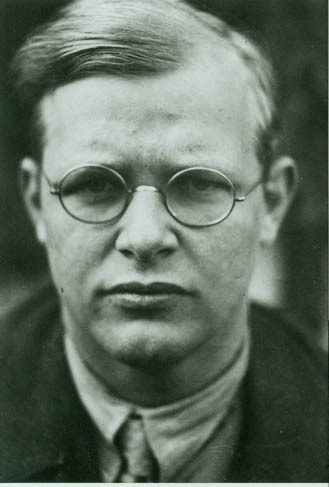
"Such grace is costly because it calls us to follow, and it is grace because it calls us to follow Jesus Christ. It is costly because it costs a man his life, and it is grace because it gives a man the only true life. It is costly because it condemns sin, and grace because it justifies the sinner. Above all, it is costly because it cost God the life of his Son: 'ye were bought at a price,' and what has cost God much cannot be cheap for us. Above all, it is grace because God did not reckon his Son too dear a price to pay for our life, but delivered him up for us. Costly grace is the Incarnation of God."
Saturday, July 23, 2011
Dietrich Bonhoeffer on cheap grace and costly grace
"Such grace is costly because it calls us to follow, and it is grace because it calls us to follow Jesus Christ. It is costly because it costs a man his life, and it is grace because it gives a man the only true life. It is costly because it condemns sin, and grace because it justifies the sinner. Above all, it is costly because it cost God the life of his Son: 'ye were bought at a price,' and what has cost God much cannot be cheap for us. Above all, it is grace because God did not reckon his Son too dear a price to pay for our life, but delivered him up for us. Costly grace is the Incarnation of God."
Monday, June 27, 2011
Reflection: Sin, grace, salvation and our attitude toward others
For if we realise how sinful we are we would not claim that we are always right, or more righteous than others. Likewise, if we truly realise how sinful we are and hence how amazing God's grace is for us, we would see our fellow human beings as fellow sinners who need God's grace (rather than "them as sinners" and "us as righteous people").
All these come back to how much we truly understand "salvation by grace", or, more precisely, "salvation by the costly grace" of the Crucified Christ and Risen Lord.
And as I wrote the above, I wonder how much I have fallen short of God's glory, and how thankful I am to God who has poured out his grace on me, a sinner.
Wednesday, January 6, 2010
Peace VS violence - Some thoughts
(1) The conquest in the book of Joshua is not to be treated as the norm. My reading of the Old Testament suggests that, apart from the stories surrounding the Amalekites, the conquest in Joshua is the only noticeable occasion in which God asks his people to use violence to attack a people group. We may call this war a "just war", in the sense that God himself used it for his own reasons. It seems, however, that the stories that clearly shape the life and theology of Israel in the Old Testament are not the accounts of violence but the creation narrative in Genesis, the exodus story, God's covenant with Abraham, and the expectation of restoration from exile. The conquest in Joshua seems to be a one-off event in which Yahweh fulfilled a particular purpose for a particular time and occasion.
(2) Judgment and vengeance on God's enemies are God's prerogative alone. Any intention to use violence to resolve conflicts must take this notion seriously. The term "holy war" is not found in the Bible. Rather, we have the concept of "Yahweh's wars". Here is what Paul says in Romans 12:19-21, citing Deuteronomy 32:35 and Proverbs 25:21-22.
"Beloved, never avenge yourselves, but leave room for the wrath of God; for it is written, 'Vengeance is mine, I will repay, says the Lord.' No, 'if your enemies are hungry, feed them; if they are thirsty, give them something to drink; for by doing this you will heap burning coals on their heads.' Do not be overcome by evil, but overcome evil with good."
Only God is the author of life, and only he has the right to judge the world. The New Testament states clearly that Christ is the Judge, and one day justice will be done. The Christ-community looks to Him to judge the world as they suffer from violence in this world. This future judgment is, however, also restorative. As the Christ-community seeks to overcome evil with good and wait on God for his just judgment, it has an amazing restorative purpose - because it calls people to stop their acts of violence and turn to God for his mercy and grace.
(3) I respect those who hold the view that in exceptional cases a measured expression of violence might be necessary as the last resort. For example, some argue that in the case of the genocide in Rwanda, it would have been a different outcome if there had been a United Nations peace-keeping force to prevent violence in the nation. I also want to say that in my personal life I have not experienced strong political oppression, and hence I am not in a position to judge others. If a Christian decides to defend her/his family and loved ones when their lives are under threat because of their faith, who am I to judge them for their defensive action, which is used as the very last resort?Obviously much more needs to be said on this topic. But space does not allow me to systematically discuss this matter.
For me, Jesus' teaching on loving one's enemies and praying for them is the key. Christ died for sinners. His willing sacrifice for humanity is how his love works in practice. His teaching on forgiveness and loving one's enemies was given in the context of Roman occupation (by violent means) of Judea, including Jerusalem. The earliest Christians also lived in the Roman Empire, where there was much violent oppression. But from the birth of the church in Acts to the writing of Revelation we find no intention in the earliest church to repay violence with violence. Rather, the Christ-community sought to live in peace with their neighbours. learned to love them (including their enemies) and often that meant suffering and dying for their faith. For me, if one holds on to Christ's teaching here, it is hard to accept the use of violence in resolving conflicts. The passage in Romans 12 above says it all.
I am all for peace-making!
Friday, November 27, 2009
Amazing grace: Roman justice VS the saving restorative justice of God
Here is another quote from Michael Gorman's Reading Paul.
"Roman justice was a way of bringing order out of chaos, but it resulted in a system of more justice for some (the elite) and less for others. Furthermore, it required a system of punishment and deterrence that included the shame of public crucifixion for those who threatened the order that Roman justice created. In other words,... Roman justice required the exclusion and even the destruction of anyone perceived to be a threat to the peace/the social order/justice. The descendants of Roman justice, including certain contemporary versions of domestic as well as international justice, inevitably follow a similar pattern, culminating in the destruction of the enemy...
The saving, restorative justice of God revealed in the gospel is an alternative way of setting people right with God and with one another. It takes place not by inflicting violence to the enemy, but by absorbing violence on behalf of the enemy. Its extreme modus operandi is not to crucify but to be crucified. It does not require the destruction of the enemy but the embrace of the enemy. The justice of God, therefore, is not the opposite of compassion but the very expression of compassion. It is at once the manifestation of God's faithfulness, because this is the way God is, and of God's grace, because it is not what humans deserve. Romans 3:21-26 and especially 5:6—8 demonstrate that Christ crucified displays this kind of divine justice, simultaneously revealing that "normal" forms of justice are in fact alien to the gospel:For while we were still weak, at the right time Christ died for the ungodly. Indeed, rarely will anyone die for a righteous person - though perhaps for a good person someone might actually dare to die. But God proves his love for us in that while we still were sinners Christ died for us. (Rom 5:6-8)"
If Gorman is right, there is much for us to reflect on.
Thursday, November 26, 2009
Discipleship re-visited, as the church faces the temptation of cultural captivity
Here is another quote from Michael Gorman's Reading Paul."Today, once again, many Christians and churches face the temptations of cultural captivity, 'spirituality' without discipleship or ethics, and knee-jerk nationalism. These are all forms of cheap grace, or cheap justification—a relationship with God in which God is believed to be a kind of cosmic agent of 'salvation' (happiness, blessing, security, prosperity, etc.) who requires little or nothing of the allegedly 'saved' or 'blessed.' Cheap justification is justification without transformation, without conversion, without justice. Once again, someone needs to speak, not merely of grace, but of costly grace; not merely of justification by faith, but of costly justification by faith. That someone is Paul."
Of course the language of "cheap grace" and "cheap justification" is not found in Paul's letters (not literally). But Gorman's critique must be heard. Any reading of Paul's letters will find that as Christ-followers we are challenged to follow the way of the Cross. At the heart of his letter to the Romans, we find a very important verse.Now if we are children, then we are heirs — heirs of God and co-heirs with Christ, if indeed we share in his sufferings in order that we may also share in his glory. (Romans 8:17)
In the Greek the words for "co-heirs", "share in his sufferings", and "share in his glory" start with the same prefix, which means "with-" in English. This means that, for Paul, the three are all very important and are indeed interlocking ideas and cannot be separated (especially with the connecting words "if indeed" and "in order that").
Discipleship can be costly. I personally find it very challenging. But I think ultimately it is the love of Christ that compels us to follow him wholeheartedly. For me, I am very much aware of my limitations and weaknesses, and I ask the Holy Spirit to help me on the journey.
Wednesday, August 26, 2009
Who is Tom Wright?
Some time ago I spoke at a Christian gathering about the righteousness and justice of God as well as the lordship of Christ. I used some of N T (Tom) Wright's material in my presentation. Afterwards someone asked me about Tom Wright's teaching because she had heard some negative comments about him.I don't intend to defend Tom Wright's theology here. But I think it is unfortunate that Tom Wright has attracted quite a few negative comments about his teaching. Tom Wright is a fellow follower of Jesus who has made significant contribution to the church and the academic community. Wright is not always right. Nor is anyone of us.
One rather unfortunate misunderstanding is the association of the so-called New Perspective with Tom Wright. Some Christians express grave concerns about the New Perspective. But one must note that Tom Wright would have disagreed with certain views of E P Sanders, who is a leading figure of the New Perspective. In Wright's writings he regularly points out how Sanders has got it wrong (but agrees with him at certain points, as every good academic would have done).
In a previous post, I have mentioned how I came across Tom Wright's books. (Click here for the post.) But here I would like to say again that respected scholars like Gordon Fee has spoken very kindly of Tom Wright. Click here for an interview with Fee. Similarly, people like J I Packer have recommended Wright's books. (See back cover of some of Wright's books.) I have read books written by respected respected Christian leaders/scholars like Christopher Wright, Richard Hays and others, and often they cite Tom Wright and use his materials.
(An informed reader would know that there are other opponents of Tom Wright, who come from the other end of the theological spectrum. Space does not allow me to deal with that.)
I also found an article written by Doug Green, who is a professor at the Westminster Theological Seminary. This article is worth reading if one wants to read something from a conservative evangelical perspective. Click here for the article.
It does not mean that Fee, Packer and others would have agreed with Wright all the time. Nor does it mean that Wright would have agreed with them totally. But it does mean that Tom Wright is well received by respected evangelical Christian leaders.
Everyone has to read the Bible and determine whether they agree with Tom Wright. I can only let his own teaching speak for himself. But I feel a bit sad to find that people reject a Christian like him when they themselves haven't read much of him. Let's be a bit more gracious toward one another.
Sunday, August 23, 2009
God's plan for us - Jeremiah 29:11
I already talked about the word "prosper" (or "peace") in this verse in a previous post, and said that the original Hebrew word shalom conveys a much richer meaning than peace or prosperity.
Here I want to look at the context of the verse closer. The verse is part of a letter to the exiles in Babylon. The LORD's word to them was that he would bring them back from exile to their own land.
Jeremiah 29:10-14 is one of my favourite passages in the Bible. It's such a comforting passage, and it lifted my heart many times when I was going through the trials and difficulties in life. I have no problems in applying this verse to our individual circumstances.
But I do wonder whether we do take this passage too far at times. Surely the original setting of the passage is that God would rescue his people - a people suffering from oppression and immense hardship, because of their own sin and rebellion, I must add.
If anything else, the passage is about God's love for his own people, despite their own sinfulness and disobedience. But it must be remembered that this people was suffering from political and racial oppression. In the New Testament this mercy and compassion of God is clearly extended to all the peoples in the world, for the gospel is not just for the Jews but also for the Gentiles. (One must also note that this concept of worldwide lordship and compassion of Yahweh is already present in the Old Testament.)
Thus "God's plan for us" must not be understood in individualistic terms. It is not about "what's in it for me". Instead, it is about God's justice and mercy for all of his image-bearers, despite the fact that that image is no longer perfect after the fall.
On the one hand, let's take comfort from this verse as individuals. Faith in Christ is intimately personal. But on the other hand we should not privatise our faith. God's plan is for the whole humankind, and let's share this message of hope with the world, especially those suffering from hardship, poverty and injustice.
Sunday, July 12, 2009
Plans to "prosper us" - What does it really mean?
For I know the plans I have for you," declares the LORD, "plans to prosper you and not to harm you, plans to give you hope and a future. (NIV)
For I know the thoughts that I think toward you, says the LORD, thoughts of peace and not of evil, to give you a future and a hope. (NKJV)
For surely I know the plans I have for you, says the LORD, plans for your welfare and not for harm, to give you a future with hope. (NRSV)
In using the word "prosper", I think the NIV is trying to highlight the extravagant grace of God for his people despite their sinfulness and disobedience. Israel was going into exile because of their sin, but Jeremiah prophesied that God would restore their fortunes in 70 years.
Unfortunately in our Western world today the word "prosper" carries a connotation that (I think) does not reflect the Hebrew word in the original language. Today, to be prosperous often means "to be wealthy and affluent - primarily in terms of one's material possession and success in the soceity". Also, prosperity in our world today is often measured by the excess wealth and luxuary people enjoy. This meaning (ie. the excess ownership of material possession), I believe, does not reflect what Jeremiah says.
The Hebrew word used in the passage is shalom. What is shalom? According to the usage of the word in passages Isaiah 32, 65 and Ezekiel 34, shalom seems to refer to wholeness and well-being in all our social, ecological, political, agricultural and economical relationships, which are in turn rooted in a restored covenant relationship with God. It is about peace, security, wholeness and well-being in all relationships. It is about what we can experience in Christ as we seek to love God and one another here on earth now, but its final and complete realisation will only take place at the final renewal of heaven and earth.
So let us take comfort in the fact that the LORD knows his plans for us - plans to give us shalom! But let us not turn this into a self-centred pursuit of pleasure and prosperity, which is a temptation in our materialistic and individualistic world today.
Friday, May 8, 2009
The Crucified and the cross, that "eminently counter-cultural symbol"
“All sufferers can find comfort in the solidarity of the Crucified; but only those who struggle against evil by following the example of the Crucified will discover him at their side. To claim the comfort of the Crucified while rejecting his way is to advocate not only cheap grace but a deceitful ideology.”
“In a world of violence, the Cross, that eminently counter-cultural symbol that lives at the heart of the Christian faith, is a scandal.”
Wednesday, April 29, 2009
Humility and grace
"It is not about our organisation, but about the people we seek to serve."
"We have a great history. But it is not for us to be proud of - instead, it is for us to remember God's faithfulness."
"There is no place for triumphalism or superiority... there has to be cross-centred humility."
