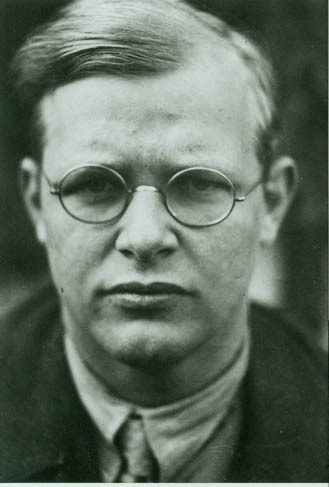
Wednesday, October 12, 2011

Performing the divine warrior - Tim Gombis

In his book The Drama of Ephesians, Tim Gombis says the following in a chapter entitled "Performing the Divine Warrior" (page 156). I will highlight a few things in this colour in italics.

"According to Ephesians, the church performs the cosmically significant role of divine warfare through mundane embodiments of God's life on earth. Cosmic conflict does not involve defiant chest thumping in the face of the defeated powers. On the contrary, we are called to purposeful, humble, cruciform faithfulness as we perform Jesus for the good of the world. As we will see, the church participates in this transformative process, it harnesses and radiates God's resurrection power, which has a transformative effect on outsiders. This is how the people of God transform their surrounding cultures. This is in direct contrast to the church's long tradition of aggressive coercion and harsh denunciation. Such strategies are surrenders in divine warfare, since they are capitulations to worldly community dynamics. The church must also be a community of wisdom and discernment. And finally, the church must be a culture of justice. When the people of God cultivate these patterns of life, the church performs the role of divine warrior in the world." (Emphasis added)

Gombis goes on to say that Ephesians 6:10-18 has more to do with Isaiah 59:15-19 than the armour of a Roman soldier. (pages 157-8)

Then Gombis says,

"The enemy in the church's warfare is not the world or people in the world but the powers. And, as we will see, the strategy is not militant. In fact, Paul's instructions for engaging the spiritual conflict are quite subversive, upending notions of militancy. But we should expect such a move by this point. Throughout the Old Testament, human actors in divine warfare episodes subvert expectations by taking on postures of weakness. Paul performs his role in continuity with this theme through cruciformity; he imitates the earthly performance of Jesus by inhabiting a role of humility, self-sacrifice and weakness. Paul purposefully performs a cruciform role so that God's triumph might be seen clearly by the powers he has defeated in Christ." (Page 159; emphasis added)

"Our warfare involves resisting the corrupting influences of the powers. The same pressures that produce practices of exploitation, injustice and oppression in the world are at work on church communities. The church's warfare involves resisting such influences, transforming corrupted practices and replacing them with life-giving patterns of conduct that draw on and radiate the resurrection power of God. Our warfare, then, involves purposefully growing into communities that become more faithful corporate performances of Jesus on earth." (Pages 159-160; emphasis added)

Sunday, October 9, 2011

What the ministry of reconciliation requires - 2 Corinthians (Capes, Reeves and Richards)

In their Rediscovering Paul, Capes, Reeves and Richards, provide us with some great stuff about 2 Corinthians (pages 160-1). I will highlight a few things in blue.

"According to Paul, his converts had failed to recognize what the ministry of reconciliation required. It meant 'carrying in the body the death of Jesus' (2 Cor 4:10), and 'walk[ing] by faith, not by sight' (2 Cor 5:7), 'regard[ing] no one from a human point of view' (2 Cor 5:16) and living as 'having nothing, and yet possessing everything' (2 Cor 6:10). In other words, it meant living like Jesus ('though he was rich, yet for your sakes he became poor, so that by his poverty you might become rich,' 2 Cor 8:9), and emulating Paul ('as servants of God we have commended ourselves in every way; through great endurance, in afflictions, hardships, calamities, beatings, imprisonments,' 2 Cor 6:4-5). The Corinthians needed to learn what it meant to become living sacrifices for the welfare of others. This is why the paradox of Christian existence is the leading motif or 2 Corinthians: 'for whenever I am weak, then I am strong' (2 Cor 12:10). The strength-in-weakness theme pervades the entire letter in a variety of apparent contradictions, including joy in suffering, generosity in poverty and life in death. For Paul the theological basis for this paradox is the life, death and resurrection of Jesus. In weakness and suffering Jesus descended into death; in power and joy God raised him from the dead. Therefore, weakness is strength, death is life, and humiliation is glory."

Major demographic change in Christianity (Sight Magazine)

Sight Magazine has a new article about the major demographic change in Christianity. Here are some interesting observations. (I will highlight a few things in blue.)

"According to Peter Crossing of the Center for the Study of Global Christianity, in 1910 about 66 per cent of the world's Christians lived in Europe; a century later it was only 26 per cent."

"He added that Christians in the northern hemisphere still dominate financially; 60 per cent of the world's Christians live in the southern hemisphere, but they generate only 17 per cent of Christian income."

"The global reconfiguration raises critical questions for all churches, said Dr Robert. "Contemporary Christians are focusing on mission for multiple purposes--both to recover tradition and to recover from tradition."

""Conversations about mission and witness have become an urgent agenda for declining mainline Christians...as they struggle to reframe their identity in a global marketplace. At the same time, adherents of new ministries often see their witness as a recovery of primitive Christianity that challenges the older denominations," he said."

A few thoughts: (1) Financial prosperity does not mean a vibrant faith. (2) Tradition has pros and cons. (3) The Christianity in the earliest church (as in the New Testament) seems to be the best frame of reference for the church today.

(Click here for the full article.)

Tuesday, October 4, 2011

The Lost Letters of Pergamum by Bruce Longenecker (A book review)

Sight Magazine has just published a book review I just wrote. It is a review on Bruce Longenecker's The Lost Letters of Pergamum (Baker, Grand Rapids, 2003). Here are parts of the review.

"The genius of this book is Professor Bruce Longenecker’s ability to narrate a powerful tale through the lens of early church history. At the same time the story of Jesus is retold through the fictional accounts of Antipas and the early Christians in Pergamum. As a result, we modern readers reap the benefit of learning from Longenecker (a prominent Biblical scholar) important elements of New Testament history through a very user-friendly story. We are indebted to Longenecker for teaching us something about Luke’s Gospel, the background of Revelation, and the ancient letter writing style that shaped much of the New Testament."

"The Lost Letters of Pergamum is not so much a light bedtime reading. But neither is it an academic book that demands a heavy intellectual engagement. Rather, it is for Christians, pastors, theological students, and even children (from upper primary onwards), who want to gain insights into the New Testament and the power of the Gospel through a superb storyline that is both intriguing and engaging. I highly recommend this book."

Click here to read the entire book review.

Monday, October 3, 2011

Wealth, poverty and being servants

A friend pointed me to David Chronic's article about Jesus' being a servant. I think he makes some very good points here. Although some may disagree with his view on economics, he is right about exploitative power dynamics and the sinful human nature that tends to misuse power. Here is an excerpt.

"Early in my Christian walk, Jesus’ words, “Go and sell what you have, give to the poor, and then come follow Me,” challenged me to simplify my life in order to serve God. I didn’t hear these words as a harsh, top-down command; rather, I saw how Jesus modeled this message and invited me to walk after Him. He gave up the riches of heaven to “take the nature of a servant” (Phil. 2:7). His actions encouraged me to give up my comforts and to become a servant. In my experience of “downward mobility,” I identified myself with Jesus’ move from master to slave or royalty to servant — or at least, so I thought. Focusing on Jesus’ actions, I missed something essential about the nature of God. And it has been among socially and economically excluded peoples that my eyes have been opened to see beyond God’s serving actions to God’s servant nature.

I had thought that the move of Jesus was one from lord to servant, a sort of trickle-down movement. Margaret Thatcher, a former British prime minister, is quoted as saying that if we want to serve the poor, we need to empower the rich. When the rich have wealth, they, like the Good Samaritan, take care of the poor. Since Thatcher said that, the trend of the rich getting richer and the poor poorer has debunked her trickle-down theory.1 Never having “enough,” the rich tend to serve their own interests — without “taking the form of a servant.”

Not only do we rarely see servanthood modeled by the upper classes in the stewardship of their power and possessions, but it is among the marginalized and oppressed that we find amazing lessons of servanthood. One of our friends, a mother of five, awakens early to go to the market. She spends the days cooking, cleaning and caring for her kids. On top of all this, she is always looking for odd jobs to bring some income to the family, often working late into the night. Although extremely poor, she is one of the hardest-working people I know, and she does it for the love of her family."


(Click here for the entire article.)

Sunday, October 2, 2011

The Mission of God (Rev Dr Christopher Wright)

This YouTube clip summaries Rev Dr Christopher Wright's view on the mission of God. It's really worth watching.

Saturday, October 1, 2011

Identity formation (by Tim Gombis)

Tim Gombis posted a post entitled "Identity Formation" in his post yesterday. Here is an excerpt. I really like it.

"Jesus is God’s solution to the brokenness of the world, and he redeems and saves by becoming brokenness, by going to those that are broken and beaten-down, by becoming the outcast and the stranger, by dying.

God shouted a resounding “YES” to what Jesus did by raising him from the dead and installing him as King over all creation.  When Jesus sat down on his heavenly throne, he sent his Spirit to dwell among us.  Not someone else or something else, but Christ’s own Spirit—Christ Jesus himself is here among us."

(Click here for the entire blog post by Tim Gombis.)

The "grammar of the gospel" (Tim Gombis)

In a recent post in his blog, Tim Gombis says something profound about the gospel. He makes six points in his post, I am citing the first three here (and I will highlight a few things in this colour).

"First, because the gospel is the announcement of the arrival of the Kingdom of God, talk about any part of that multi-faceted redemptive and world-altering reality is “the gospel.”  All of these, then, are proclamations of the gospel: forgiveness in Christ for the guilty; a warm welcome among the body of Christ for the lonely and alienated; God’s defeat of Sin and Death in Christ; a satisfying meal among God’s people for the hungry; liberation from bondage through God’s Spirit and God’s people; reconciliation in Christ for formerly alienated groups.  These concrete realities, and so many others, are instantiations of God’s Kingdom as it invades and begins to transform an enslaved cosmos.

Talking about any of them is talking about the gospel.

Second, the “call” of the gospel is the call to turn from sin, selfishness, and idolatry, and to take on Kingdom practices that enact, embody, activate, and participate in that reality.  The call of the gospel, then, is exhorting all people to receive forgiveness in Christ, to forgive others in Christ, to serve the poor in Christ, to reconcile with former enemies in Christ, to stop oppressing and manipulating others in Christ, to receive others as gifts in Christ, to celebrate redemption in Christ, to give thanks to God in Christ.  Concrete practices such as these are embodiments of Kingdom participation that draw upon and radiate God’s presence and power by God’s Spirit.

To do any of them is to respond to the gospel.

As I said previously, the gospel speaks with a variety of voices depending on the situation.  To those oppressing others, the gospel will speak a word of rebuke and a call to inhabit the life-giving Kingdom of God along with others.  To those trapped in despair, the gospel sounds a note of sweet grace, relief, and comfort.  Christian people must inhabit and explore the richness of the gospel to learn how it overwhelms and transforms any and all situations for the glory of God and the good of the world.

Third, to respond to the gospel is to be compelled by this Kingdom reality and to begin enacting Kingdom behaviors among God’s people in Christ."

Tim Gombis refers to Scot McKnight's new book, The King Jesus Gospel: The Original Good News Revisited. It seems that there are points of contact between his and McKnight's understanding of the gospel. I have previously blogged about McKnight's new book, which can be found here and here.

(Click here for Tim Gombis' entire blog post.)

Saturday, September 24, 2011

God chooses the weak and the despised

I'd like to share a bit more from Professor Bruce Longenecker's book The Lost Letters of Pergamum: A Story from the New Testament World. 

This book consists of a set of fictional letters between a number of people in the first century. Here is an excerpt from a letter written to Luke (the writer of Luke's Gospel) from a nobleman in Pergamum, after reading the last chapters of Luke's Gospel. The nobleman is not a Christian at this point.

"Clearly, the punch of your narrative comes at the very end, with the resurrection of Jesus and his ascension into the heavenly world. These acts seem to be more than a simple vindication of one who claimed to act on behalf of his god. They reveal that Jesus can fill the role he predicted for himself - that of the ultimate and sovereign judge of the world, the Son of Man exalted to the right hand of the mighty god. I noted that this provided the narrative with a fitting point of closure, with the resurrection of Jesus highlighting the point he had made throughout his life: Jesus' god chooses the weak and despised as the favored vehicles of divine power and mercy. That a crucified outcast is resurrected by divine power is itself a most dramatic example in the theology of reversal that Jesus espoused throughout his life."

By the way, if you are wondering where Pergamum is (in the Bible), check out Revelation 2:13.

Counter-imperial gospel (?) - Some interesting thing from Michael Bird

In a recent post in his blog, Michael Bird said that he's increasingly convinced that the gospel would have been perceived as counter-imperial. Here is an excerpt from his post.

"Paul’s colleagues in Thessalonica were mobbed because: 'They are all defying Caesar’s decrees, saying that there is another king, one called Jesus' (Acts 17:7).  This story reminds of an an episode from Caligula’s life described by Suetonius (Caligula 22):

'Upon hearing some kings, who came to the city to pay him court, conversing together at supper, about their illustrious descent, he exclaimed,
Eis koiranos eto, eis basileus.
Let there be but one prince, one king...'"
Click here to see the rest of Michael Bird's blog post (6th September 2011).

Thursday, September 22, 2011

Australians (generally speaking) are not poor

Recently the ABS released the results of a survey on Australian Household Expenditure on Goods and Services for the 12 months prior to June 2010.  (Click here for the link to the ABS survey.) Here are some of the stats from the survey.

This means that the annual expenditure of an average Australian household is over $64,000, and that of a household with children is over $106,000.

Let me put this in perspective. For our family, our net income (after tax) is less than the average household expenditure ($1,236), and hence is much less than the average family expenditure ($2,046). How do we survive? By having a weekly expenditure that is closer to that of a household which relies on government pensions and allowances ($613).

(Both my wife and I work in Christian organisations. That explains our salary rates.)

As Christians, we have financial commitment to our church, mission, and overseas relief and development organisations. We also provide financial support for a parent overseas. But overall we are surviving (well, not very easily, and with a level of stress).

And, amazingly, our life is still much better off than the majority of people in the world, where 22,000 children in low-income countries die before the age of five because of preventable diseases.

Australians, in general, are not poor. Of course, there are those at the lower end of the socioeconomic scale who suffer - and we need to stand in solidarity with them. But for the rest of us, let us be loving and generous to those who are less fortunate than we.

Turning away from racism - The candid confession of John Piper

Christianity Today just published an article online. It is an excerpt from John Piper's new book. Here are some excerpts from the article.

Piper tells stories about the early part of his life, and confesses that he was racist. But many years ago, Piper moved into a multi-ethnic city. This is what he has to say about the city.

"We moved into the city and have lived within walking distance of the church in Elliot Park and Phillips ever since (now almost thirty years). The 2005 ethnic breakdown of our neighborhood was 24.6 percent Caucasian, 29 percent African American, 22 percent Hispanic, 11 percent Native American, 5.9 percent Asian, 7.4 percent other. Immigration patterns have changed over the years with various groups swelling and shrinking from time to time. But that is pretty much what I see out of my study window on 11th Avenue South."

At the age of 50, Piper and his wife were asked to adopt an African American girl. This is what he says.

"Noël and I took long walks together in those days as we sought the Lord together. Finally, I knew the answer. Love your wife, love this little girl as your own, and commit yourself to the day of your death to the issue of racial harmony. Nothing binds a pastor's heart to diversity more than having it in his home. That was over fifteen years ago. In those years, we have tried to pursue as a church a deeper and wider racial and ethnic diversity and harmony." 

But this candid confession of Piper is most interesting.

"If any of this sounds valiant, don't be too impressed. I am not a good example of an urban pastor. Because of the way I believe God calls me to use my time, I don't have significant relationships with most of my neighbors. Nor does our church reflect the diversity of this neighborhood.

There is diversity, but nothing like the statistics above. Probably I could have been far more effective in immediate urban impact in this neighborhood if I had not written books or carried on a wider speaking ministry. Some thank me for this ministry, and others think I have made a mistake..."

I think there is much to ponder.

Click here to read the whole article.

Tuesday, September 20, 2011

Galilean life from a peasant's perspective (Bruce Longenecker's book)

I am enjoying an excellent book written by Professor Bruce Longenecker called The Lost Letters of Pergamum: A Story from the New Testament World.

It is an excellent book that will help you to understand the New Testament. The following recommendation by Professor Stanley Porter tells us what the book is about.

"This fictional correspondence is not true, but it certainly could have been. Longenecker writes a very engaging account of several characters who, in their different ways, came to experience and respond to the risen Jesus Christ through Luke's narrative. I was especially moved by the character of Antipas as he is ennobled by being transformed from a Roman dignitary into a model of Christian self-sacrifice."

The book consists of many letters written by Antipas, Luke, and others. Here is an excerpt from one of the digests, in which Antipas gives an account of what Galilean life was like from a peasant's perspective.

"Like most other sectors of society throughout the empire, Galilean society is marked by two tiers of position: those in secure positions and those in insecure positions. Those enjoying a high degree of security are members of the elite, the ruling class and their high-ranking retainers. Those in an insecure situation include the peasants, most artisans and merchants, along with the unclean, the degraded, and the expendables. Although those in secure positions of wealth and power are few in number, they control the majority of the wealth of the society. The elite enjoy an extremely extravagant lifestyle, while the majority of the peasants live the most meager existence.

The elite have the luxury of establishing profitable relationships with other members of the elite, usually facilitated by means of lavish banquets that parade their wealth and opulence in contests of consumption. A member of the elite continually seeks ways of increasing his influence through investment opportunities, business partnerships, patron-client relationships, currying favor with imperial officials, or serving lucrative ambassadorial function on behalf of his city... The elite portray themselves as favored by the gods and go to great lengths to ensure that the religious institutions of the society promote this claim...

Rural peasants, conversely, expend significant energy simply trying to ensure the survival of themselves and their families. They usually live meager lives at subsistence level, having just enough food and resources to get by. Many fall below that level. Their poor standard of living is not the result of laziness or ineptitude, since a peasant's workday is long and hard. Nor is it the result of poor harvesting techniques, since peasant farmers reap significant gains from agricultural production. Instead, subsistence living is the result of imposed dues, tributes, and taxations, which peasants usually regard as excessively harsh because these expensive burdens extract everything over and above what is required to sustain the peasants' meager existence."

Tim Gombis on the pre- and post-conversion Paul

Tim Gombis has written some really good posts in his blog. Yesterday he posted something on "Paul the Pharisee", which says some very good stuff on the pre- and post-conversion Paul. Really worth reading. Here are some excerpts. (The "blue" highlights are emphases added by me.)

"Before his conversion, then, Paul was part of an effort to bring about a renewed nation, to present to God a purified people, zealous, like Paul, for the “traditions of the fathers” (Gal. 1:14).  He was likely convinced that once the nation was pure and obedient, God would be moved to send Messiah who would bring God’s salvation.

Further, this was done through violence, coercion, and persecution of sinners among the people.  This explains Paul’s persecution of the early Jesus-followers.  Because they were worshiping the one whom God had cursed (Gal. 3:13/Deut. 21:23), they were standing in the way of God fulfilling his promises.

After his conversion, of course, Paul’s ultimate aims don’t change.  He is still passionate about the resurrection of the dead and God fulfilling his promises to the fathers (Acts 26:6-7).  It’s just that now Paul knows that this eschatological orientation involves suffering with the persecuted, multi-national people of God, praying and longing for Christ’s return, and participating with the Spirit’s project of producing cruciform, non-violent love among the people of Jesus.
.............

But the contrast between pre- and post-conversion Paul is not that he once was a legalist and is no longer.  The contrast had to do with the manner in which he conceived of God fulfilling his promises to Israel.  How would this come about?  Does God act to restore his people by his own grace?  Or can you violently coerce conformity to the Law to produce a people that will move God to act?

The contrast is between coercive and manipulative treatment of God and others, on one hand, and self-giving love for God and others, on the other.

Previously, Paul violently coerced others and sought to manipulate God to act.  He now loves others, suffering on their behalf and praying for their good.  And his posture toward God is one of deference, praying for and longing for the day of Christ, knowing that God in his wisdom will come to save in his own time."

Click here for the entire blog post.

Monday, September 5, 2011

"Lament for a Neighbourhood" by Tim Gombis

Here is a profound prayer by Tim Gombis in his blog on 3rd September 2011. (Click here for the post.)

"Father, we hate that your world is broken,
and we confess that we are broken, too.
Our hearts break at the brokenness of this neighborhood,
and at our own inadequacy to fix any of it.
How long, O Lord, will you let your people suffer,
and let those created in your image languish in poverty,
fear, rejection, abuse, imprisonment, addiction, relentless sorrow?
Come and save; come and restore;
heal our hearts; without you we are completely lost."

Joel Willitts' comments on Scot McKnight's The King Jesus Gospel

Joel Willitts has posted two posts in Euangelion about Scot McKnight's book The King Jesus Gospel, which I mentioned in my previous post. Here is an excerpt from Willitts' comments.

"Here’s the central issue Scot is tackling in the book, and its one that has been a perennial discussion since at least the time that I’ve been an adult Christian: Evangelism as a call to decision versus evangelism as a call to a life of discipleship. The former has led to the problem of having “The Decided” in our pews who are yet “The Discipled”. According to Scot, this problem has been created by our “Plan of Salvation” gospel theology. While in no way downplaying the need for a decisive action as a first step, Scot argues that the biblical gospel must be defined such that the end goal is not only or singularly “personal salvation” from sin, but salvation from sin so to participate in God’s epic story of world rescue."

Click here and here for Willitts' posts.

Tuesday, August 23, 2011

Scot McKnight's new book The King Jesus Gospel

Mike Bird just posted this promo clip of Scot McKnight's new book The King Jesus Gospel.


It is really worth watching.

(Click here for Mike Bird's blog post.)

Saturday, August 20, 2011

God uses the weak and lowly to show us profound truths

Sight Magazine has just published my latest article. Here is what the editor says.

"I think the educated, the unlearned, the rich, and the poor, all have gifts and talents to build up the body of Christ. The most important person in the Bible is Jesus, and He does not grade people according to their social or economic status. Our pastors, teachers and conference speakers should be people who can help us know Christ and the Scripture. Their qualifications and ministry success – or their lack of them – simply cannot be our primary focus."

"The most inspirational people are often the least known people, including those at the margins of the society."

I then survey the New Testament and find some "unknown" people who have been most inspirational. After that I look at two communities that I participate in, and show that God does speak through the weak and lowly.

Click here for the full article.

Saturday, August 13, 2011

Bonhoeffer on the Cross and Truth (from Nijay Gupta)

Nijay Gupta just posted this great quote from Bonhoeffer.

"The only basis of the disciples’ truthfulness is that Jesus, while we follow him, reveals our sinfulness to us on the cross. The cross as God’s truth over us is the only thing that makes us truthful. Whoever knows the cross no longer shies away from any other truth."

(Click here to Nijay Gupta's post.)

Thursday, August 11, 2011

Forgiveness is powerful, beautiful, messy, and risky - Tim Gombis

Tim Gombis has written a really good blog post about forgiveness.

Everything in the post is good. Here are some excerpts.

"Forgiveness is so profoundly powerful and beautiful... Forgiveness doesn’t ask for guarantees... Forgiveness takes the risk... Forgiveness doesn’t fix everything... Forgiveness doesn’t guarantee a Disney ending... Forgiveness doesn’t clean up the whole mess... Forgiveness remains difficult, complicated, risky, and profoundly beautiful."

Click here for the entire post.

Monday, August 8, 2011

Some thoughts on mission (especially cross-cultural mission) - Part 2

This post continues from my last post on my thoughts on mission (which can be found here.)

Proclamation
The proclamation of the gospel is found throughout the narratives in the Gospels and Acts. Cross-cultural mission (and mission in general) can especially be found in Acts. But I think we need to note the content of the gospel message. The gospel message is multifaceted. Here I will list a few Scriptures. In Athens, Paul says,
“The God who made the world and everything in it is the Lord of heaven and earth and does not live in temples built by human hands. And he is not served by human hands, as if he needed anything. Rather, he himself gives everyone life and breath and everything else.   (Acts 17:24-25; emphasis added)
In the past God overlooked such ignorance, but now he commands all people everywhere to repent. For he has set a day when he will judge the world with justice by the man he has appointed. He has given proof of this to everyone by raising him from the dead.” (Acts 17:30-31; emphasis added)
Later in Acts Paul recalls what Jesus said to him,
‘I am Jesus, whom you are persecuting,’ the Lord replied. ‘Now get up and stand on your feet. I have appeared to you to appoint you as a servant and as a witness of what you have seen and will see of me.  I will rescue you from your own people and from the Gentiles. I am sending you to them to open their eyes and turn them from darkness to light, and from the power of Satan to God, so that they may receive forgiveness of sins and a place among those who are sanctified by faith in me.’ (Acts 26:15b-18; emphasis added)
Paul, who was Jewish, was sent to the Gentiles and Jews alike to proclaim the good news of Jesus. Note that it is a message of the lordship of the Creator God, God's judgment with justice, repentance, forgiveness of sins, and, most importantly, the death and resurrection of Christ. As Paul says in 1 Corinthians 15:3-4,
For what I received I passed on to you as of first importance: that Christ died for our sins according to the Scriptures, that he was buried, that he was raised on the third day according to the Scriptures...
Here I want to point out a few things about the proclamation of the gospel.

(1) My former religion was a mixture of Confucianism, Taoism, Buddhism and ancestral worship. One of the most significant Christian experiences for me is the fact that I am a sinner and that by God's grace my sins are forgiven. To me, Jesus is my Lord, my King and my Saviour. The lordship of Christ, I think, should be at the heart of our proclamation.

(2) The gospel message contains many elements, and should never be reduced to a simple formula. For example, the preaching of the gospel is not about "a ticket to heaven". In fact, even a casual look at the Bible passages cited above will show that the New Testament Christians did not reduce the gospel to "a ticket to heaven".

(3) In the Four Gospels we find that Jesus' call is that people may follow him as their Lord and King. The gospel is about the call to follow the crucified Christ and risen Lord - that is, the call to discipleship. And as Dietrich Bonhoeffer says, discipleship is about costly grace, not cheap grace. (Click here for my post about that.) The fact that proclamation of the gospel is about discipleship is evidenced by the so-called Great Commission in Matthew 28:18-20, where Jesus asked his disciples to go and make disciples of all nations. This is not about an intellectual understanding of some formulas to get a ticket to heaven, but about proclaiming the crucified Christ and risen Lord so that people will follow his self-giving way of life.

(4) Michael Pahl speaks of our call to proclaim and live out the resurrection of the crucified Christ, and that "the church is called to enact God's program of creation renewal in this age in anticipation of the fulfillment of the renewal of creation in the age to come." I have previously blogged on what Pahl says in his book From Resurrection to New Creation (Eugene: Cascade Books, 2010). I think it is really worth reading. Click here for the blog post.

(5) It is absolutely important is that we do not see ourselves as superior to those who do not know Jesus. Christians are fellow sinners who need the grace of God for salvation. We have come to know Christ because of God's grace, not our righteousness. We are to proclaim the gospel with humility, and with sincere love for those who are living in darkness.

(To be continued.)

Sunday, August 7, 2011

Community: Problem solving or problem sharing? Or solidarity?

In my last post I cited some great points made by Tim Gombis. Gombis says that sometimes churches don't quite live as communities of the cross: "They imagine that the problem is the problem.  After all, churches aren’t supposed to have problems or challenges, just as individual Christians are supposed to have perfect lives.  If there’s something wrong, then there’s something wrong!"

I have some further thoughts on this.

Because of my work and ministry I have been involved in quite a few Christian communities and churches. I am concerned when the more vulnerable members of those communities are hurt or going through a difficult time. For others, these vulnerable members are the ones who have “problems”. Often sincere and committed Christians try to help them by their "problem-solving" skills, as if there are always formulas to tackle the “problems” in people’s lives. Sometimes this works. But I would prefer problem-sharing rather than problem-solving (if we insist on using the term “problem”). If we stand in solidarity with those who are hurting and those going through hard times, and if the first thing we do is to listen and share their pain, then we are on a journey together to deal with the issues that causes the hurt and pain.

I think that’s what Jesus did when he was on earth. He walked life’s journeys with his fellow human beings. He showed us what it means to be truly human – that is, someone who is willing to share the pain, suffering and injustice in this world. Yes, he taught us how to live wisely. Yes, he taught us to pray. Yes, he spoke of God's judgment and God’s love. And so should we teach others. But his message is about God’s upside-down kingdom (or right-way-up kingdom, from his perspective). It is about “those who are first will be last, and those who are last will be first”. It is about self-giving and solidarity with the poor and oppressed. I think this is where the apostle Paul gets it right – God’s wisdom is found in the crucified Christ. And it is in the crucified Christ and risen Lord that we see God's power manifest.

Thursday, August 4, 2011

Let the gospel overwhelm and transform - Tim Gombis

Here are some excerpts from Tim Gombis's recent post in his blog. I think they are excellent.

"It seems to me that the New Testament assumes the constant rehearsal of the story of Scripture in order to shape the identity of God’s people.  We get to know God and his ways with his people as we have our imaginations shaped by the narrative of Scripture.  That’s the resurrection-powered world we inhabit, with all its possibilities, its dynamics, and its causes and effects."

"God works in power only through communities of the cross.  God unleashes resurrection power only among cruciform communities of humility and weakness.  God’s people, therefore, can adopt postures of humility toward one another and call out to God for wisdom to find a way forward through any challenge.  They then put their heads together and commit to the hard work of discussing and listening to one another in order to creatively come up with a way to deal with whatever challenge they face."

"It seems to me that here is where churches sometimes fail.  They imagine that the problem is the problem.  After all, churches aren’t supposed to have problems or challenges, just as individual Christians are supposed to have perfect lives.  If there’s something wrong, then there’s something wrong!"

"I hate Christian clichés, but I’ve never forgotten this one: “the end is the process.”"

"The goal is not simply to get rid of the problem or to get past the obstacle as quickly as possible.  The goal is to go through the hard work of discussing and listening in order to strengthen the bonds of community through that whole messy process.  Get people involved, let people give advice and counsel.  Cultivate openness, honesty, and vulnerability.  Giving people opportunities just might allow them to discover their gifts and capacities to contribute to a community.  It will allow a church to actually do the “one-anothers” of church life."

"[Y]ou only lose when you try to win.  God has already pledged his allegiance to us in Jesus, so we can’t lose.  We’re already loved by God despite our failures, sins, and shameful pasts, so there’s no way we can fail.  If working through a difficulty as a community takes more time than we thought, that’s okay.  If we think we’re going to miss out on great opportunities because we’re doing the hard work of making sure everyone is unified, that’s okay, too.  Like I said, the whole point is the process, and we win when we remain unified and grow in love for one another."

Click here to read the full blog post.

Monday, July 25, 2011

What is "social justice"? Some thoughts from my friends

Someone asked me recently for a definition of "social justice". I actually found it hard to answer her question, and so I asked some friends to help me. Here are suggestions from them. I think they are insightful.

"One of the first things that comes to my mind is that it isn't about issues, but about the breaking through of God's justice into a social/communal/corporate setting, as opposed to remaining an element of personal salvation."

"Social Justice is about seeking God's perspective on social issues and working for change so that our world (and the issues we face) look more and more like God's will."

"I would say that social justice is the setting right of all relationships in the world."

"Social justice is an expression of God's love, about the last being first and the first being last. It is about the breaking in of God's kingdom on earth."

"I also see social justice inseparably linked to hope. While it is the breaking in of God's kingdom on earth, it also anticipates the future new creation, when there will be no more tears and no more pain and the old order of things has passed away. Social justice is God's order of things, it is the restoration of creation, it is transformation, and therefore it is inherently part of salvation."

"I would prefer to talk about transformation, which includes things like social justice, personal transformation of the human heart (from selfishness to self-giving, from harbouring personal resentments to having an attitude of forgiveness etc) and care for the earth."

As for me, I think one reason why it's hard to define "social justice" is that the Bible does not have the word “social justice”. Instead, the New Testament uses the word dikaiosunÄ“, which refers to a range of notions including righteousness and justice. It seems to me that justice, according to the biblical worldview, does not separate social justice and the justice of God. The Bible speaks of a God who is righteous, justice, loving and always faithful to his covenant with his people. And this God wants his people to do what is right, just and loving; and they are to do so not only as individuals but also communally in their inter-personal relationships. Indeed, God wants us to act justice, show mercy and walk humbly with him in all spheres of life.

Ultimately, if we understand that our Christian life is about following Christ and his self-giving way of life, then walking humbly with God is about living out a cross-shaped life as disciples of Jesus.

If we understand justice from a biblical perspective, then what we call “social justice” is in fact an integral part of discipleship. It is about how we may be faithful people of God.

Saturday, July 23, 2011

Dietrich Bonhoeffer on cheap grace and costly grace

It seems that everyone is talking about Dietrich Bonhoeffer at the moment. Here are a few famous Bonhoeffer quotes I've found on the Internet.

On cheap grace

"Cheap grace means grace as a doctrine, a principle, a system. It means forgiveness of sins proclaimed as a general truth, the love of God taught as the Christian 'conception' of God. An intellectual assent to that idea is held to be of itself sufficient to secure remission of sins. The Church which holds the correct doctrine of grace has, it is supposed, ipso facto a part in that grace. In such a Church the world finds a cheap covering for its sins; no contrition is required, still less any real desire to be delivered from sin. Cheap grace therefore amounts to a denial of the living Word of God, in fact, a denial of the Incarnation of the Word of God." (emphasis added)

"Cheap grace means the justification of sin without the justification of the sinner. Grace alone does everything, they say, and so everything can remain as it was before."

"Cheap grace is grace without discipleship, grace without the cross, grace without Jesus Christ, living and incarnate."

On costly grace

"Costly grace is the treasure hidden in the field; for the sake of it a man will gladly go and sell all that he has... It is the kingly rule of Christ,..., it is the call of Jesus Christ at which the disciple leaves his nets and follows him."

"Such grace is costly because it calls us to follow, and it is grace because it calls us to follow Jesus Christ. It is costly because it costs a man his life, and it is grace because it gives a man the only true life. It is costly because it condemns sin, and grace because it justifies the sinner. Above all, it is costly because it cost God the life of his Son: 'ye were bought at a price,' and what has cost God much cannot be cheap for us. Above all, it is grace because God did not reckon his Son too dear a price to pay for our life, but delivered him up for us. Costly grace is the Incarnation of God."

"Costly grace confronts us as a gracious call to follow Jesus, it comes as a world of forgiveness to the broken spirit and the contrite heart. Grace is costly because it compels a man to submit to the yoke of Christ and follow him; it is grace because Jesus says: 'My yoke is easy and my burden is light.'"

Thursday, July 21, 2011

Some thoughts on mission (especially cross-cultural mission) - Part 1

Recently I have been thinking about my own view of mission. There are many who know much more than I, and so I don't think the following is new. But I feel that I need to formulate my view on mission in light of the Scripture and experience. Here are some initial thoughts.

Scripture
Much can be said here. But I will only mention the fact that Paul - the Jewish Christian - is an apostle to the Gentiles. In Romans we find that Paul envisions a Jew-Gentile love-centred community that seeks to follow Jesus. This community is in Christ through Jesus' atoning sacrifice, and seeks to embody Christ's self-giving life through the indwelling Holy Spirit. Paul sees this as God's saving purpose and his role is to proclaim this good news ("good news" is of course the meaning of the Greek word for "gospel") - first to the Jews, then to the Gentiles.

Christ's identification with humanity
The New Testament speaks of a God who sent his Son to our world. It talks about Christ's participation in frail humanity and suffered death as an atoning sacrifice for our sins (not least in Romans 8:3-4). There is a strong sense in which the followers of Jesus are to follow his way of self-giving life. The mission of God consists in him sending his Son to our world to accomplish his saving purpose. The vocation of his followers is to participate in his saving purpose by embodying Christ's way of life. In the context of cross-cultural mission, the messengers of the good news will do well if they enter the culture of their audience, live among them and remain there long-term, learn their language and participate in their sorrow and joy. Through this participatory approach, God's heralds of the gospel reflect God's character and love through their deeds and words. Through God's Spirit the gospel is proclaimed through his Presence in the Christ-followers.

Not everyone is called to engage in long-term cross-cultural mission. But we are all called to participate in God's saving purpose by embodying Christ's self-giving way of life in our own contexts and through our solidarity with those who engage in long-term cross-cultural mission.

(Click here for Part 2 on my thoughts on mission)

Wednesday, July 20, 2011

Gordon Fee on Revelation 20:1-6 - "the thousand years"

Every now and then people would ask me about what the "thousand years" mean in Revelation 20:1-6. Here I will cite a few comments from Gordon Fee's commentary (Eugene: Cascade Books, 2011) to help us answer that. But first, here the NIV2011 version of the passage:

"And I saw an angel coming down out of heaven, having the key to the Abyss and holding in his hand a great chain. He seized the dragon, that ancient serpent, who is the devil, or Satan, and bound him for a thousand years. He threw him into the Abyss, and locked and sealed it over him, to keep him from deceiving the nations anymore until the thousand years were ended. After that, he must be set free for a short time. I saw thrones on which were seated those who had been given authority to judge. And 

I saw the souls of those who had been beheaded because of their testimony about Jesus and because of the word of God. They had not worshiped the beast or its image and had not received its mark on their foreheads or their hands. They came to life and reigned with Christ a thousand years.  (The rest of the dead did not come to life until the thousand years were ended.) This is the first resurrection.  Blessed and holy are those who share in the first resurrection. The second death has no power over them, but they will be priests of God and of Christ and will reign with him for a thousand years."

Here are excerpts from Gordon Fee's commentary on Revelation.

"[T]he two paragraphs, both of which begin yet again with the verb 'I saw,' are best understood together as an interlude between the divine overthrow of the unholy triumvirate (Satan, the Empire, the cult of the emperor) delineated in the preceding section (19:11-21), and the final judgement of all evil, both demonic and human, in 20:7-15. Again, as throughout, judgment itself is not the last word. So the book concludes in turn with 'a new heaven and a new earth' (21:1-8), and a 'new Jerusalem' (21:2, 9-26), which evolves into a restored Eden (22:1-5)!" (page 280)

As to the question of what is the role of this passage to the narrative as a whole, Fee says,

"[S]ince Jewish apocalypses (after Daniel) regularly have such a moment in them, although this is the only instance of 'a thousand years' as such. Millennial ideas, for example, can be found in 2 Baruch 29-30 and the Psalms of Solomon 17; but neither of these specify a thousand-year time period, rather they look forward to a time of messianic bliss on earth. However, in neither of these cases is there also a final 'heavenly' existence as well. Thus, whatever millennial ideas may have preceded John, the present passage is remarkably his own, and has specifically to do with the special place Christian martyrs have in the divine economy." (page 282)

What then is the meaning of "after that, he must be set free for a short time" in Rev 20:3?

"[It] is mostly likely related to ... that John's major concern here is not with time as such, but with the special place God has reserved for those who have been killed by the state simply because they were followers of the once slain, now risen Lamb. In any case, John's obvious concern lies with the second paragraph (vv. 4-6), and thus not with the time period as such. The picture itself is ultimately about the role of the martyrs during the thousand-year period. And even though there is no specific geographical location given, John seems clearly to have planet earth still in view. This is made certain by the language about 'the nations' in verse 3 and the picture of the resurrected martyrs 'reigning' with Christ, plus the reality that it is literally sandwiched between the Last Battle in 19:11-21 and the release of Satan to 'deceive the nations' in 20:7-10." (page 282)

Here are some Fee's conclusion remarks on Rev 20:1-6.

"So John's apparent intent here is not to say something about them [ie. the martyrs], but to make sure that the reader recognizes that what is true for all believers is true for them in particular. That is, since all of God's redeemed people will experience the first resurrection, it is therefore also true that all of God's people are thereby 'blessed and holy' and will not experience the 'second death.' This, however, is especially true of the martyrs, about whom John then concludes, they will be priests of God and of Christ and will reign with him for a thousand years. Here again the reader can hardly miss the high Christology, in which the Father and Son are once more brought together at the Eschaton. What is noteworthy in this case is that the final pronoun 'him' is singular, therefore referring to Christ alone. Thus believers will serve as a kind of eternal priesthood before God and Christ, but the special privilege of the martyrs is that they 'reign' with Christ (alone) for the thousand-year period allotted especially to them. After all, according to the preceding sentence this privilege does not include 'the rest of the dead.'" (page 284)

Tuesday, July 12, 2011

My new article: The gulf between us and the poor

ETHOS at the Australian Evangelical Alliance has published my article entitled The Gulf Between Us and the Poor.

Here is the heading provided by their editor.

"The gulf between the rich and the poor is not simply an economical one. While the poor do not have moral superiority over the rich, and at least in theory our material affluence should not adversely affect our ability to understand the Bible, is our wealth a hindrance that stops us from fully understanding the plight of the poor and the Scripture?"

There is a great cartoon in the article. Have a look!

Click here for the full article.

Sunday, July 10, 2011

Reflection: Two recent movies, discipleship, justice for the oppressed

Two recent movies reflect elements of what I have been thinking in my studies and in my work in an overseas aid and development Christian organisation. Of course different people have different takes on the movies. But here are my reflections.

(1) Movie: Of Gods and Men

Based on a true story, this movie is about the choices made by a group of monks in a monastery in Algeria when their lives were threatened. I think true discipleship is ultimately about following Christ's sacrificial way of life, which is expressed in our solidarity with the community, not least those who are vulnerable and powerless. This is no abstract theology or theory, but a call to be authentic followers of Jesus.

Click here for a review from Guardian, UK.

(2) Movie: Oranges and Sunshine

This movie is based on true events that happened in the 1950s and 1960s, in which thousands of children were transported to Australia from England wrongfully. I think this movies highlights the fact that we need to recognise the fact that injustice and oppression is often embedded in a web of systemic social and individual sins. There are political, social and even religious systems and structures that oppress the vulnerable in our world. We need to stand in solidarity with those who suffer from injustice because of their powerlessness. Unfortunately Christians often are unaware of this, despite the fact that the Bible speaks of this in the Prophets (not least Isaiah, Amos, Micah, Jeremiah, Zechariah) and in Jesus' own ministry.
 
Click here for a review from ABC At the Movies.

Putting the above two reflections together, I think the church is called to participate in Christ's life, suffering, death and resurrection, just as he participated in human frailty in order to accomplish his atoning sacrifice for our sins and his redemption for his entire creation. We are to proclaim this Christ to all humankind - through our words and daily life - so that people may have hope and shalom through faith in Christ Jesus.

Saturday, July 9, 2011

Proclaiming and living out the resurrection of the crucified Christ (Michael Pahl)

I just finished reading Michael W Pahl's little book called From Resurrection to New Creation (Eugene: Cascade Books, 2010). In the following I will cite three quotes in the last chapter that are very helpful (on page 94).

The first two quotes probably require reading the book itself before one can fully grasp their significance, although they shouldn't be too hard to understand. The last quote shows how in practice the church can carry out its task of proclaiming and embodying Christ in this age.

In many ways this has been what I have been trying to say in the past five years at theological colleges and churches.

"Proclaiming and living out the death and resurrection of Jesus in faith, hope, and love, as described above, the church is called to enact God's program of creation renewal in this age in anticipation of the fulfillment of the renewal of creation in the age to come."

"Another way to look at this task of creation renewal is to see it as simply fulfilling the purpose of humanity in the image of God, ensuring and extending God's loving and faithful rule throughout the earthly creation."

"Yet another way to see this creation renewal task is to understand it as applying the resurrection reversal of the crucified Jesus to the world around us. In Jesus' resurrection, condemnation, shame, oppression, and death have been transformed into vindication, glory, freedom, and life. Thus, by the Spirit of Jesus the church is called to bring restorative care to the earth, liberating justice to the oppressed, food to the hungry, comfort to the suffering, healing to the sick, forgiveness and honor to the guilty and shamed, love to those in need, faith to those who doubt, hope to those in despair - light and life to a dark and dying world. This resurrection reversal is both our salvation and blessing and our missionary task."

The way I myself would like to frame this is through the stories in the Bible, the stories of the people of God, as well as the stories of the poor and oppressed. Through the biblical narratives we discover the story of the suffering, death and resurrection of Christ, as well as the stories of God's people (those of Israel and the Christ-community). As we enter the biblical stories we learn to appropriate those stories in our own lives and in the world. That's how we may proclaim and embody the gospel in a world out-of-joint.

N. Clayton Croy on th incarnation and the resurrection of Christ

I found the following written by N. Clayton Croy's from the website of the seminary where he works as a professor. It is about the incarnation and the resurrection.

"The twin theological themes of incarnation and resurrection are especially interesting to me. The former is God's resounding affirmation of embodied life; the latter assures us that such life is not a temporary aberration. Resurrection is God's way of saying that embodied human beings are too good an idea to have a shelf life."

Click here for the web link from which I found this quote today.

Saturday, July 2, 2011

Timothy Gombis on "God's Missional Sustenance for God's people"

Timothy Gombis has posted something really nice in his blog. It's his reflection after a number of posts on John 4. It ends with Gombis' own experience in his church. For years I have been thinking about what the Christian community should be like, and I am really glad to find that Gombis is saying something very similar to what I have in mind (and he articulates it so much better). Here are some excerpts from his blog post.

"I’ve been thinking about this in relation to divine election as the identity of the people of God.  So often we shrink back from this notion because it seems to imply an “insiders only” mentality.  “We’re God’s elect and they aren’t.”  We may have seen a doctrine of election put to use to endorse a lack of redemptive involvement in the wider culture."

"Jesus indicates, however, that it is only when the church encounters outsiders in open-ended relationships that we are sustained."

"First, we do not encounter the other—or, the world—with a posture of condescension, arrogance, or even in order to set anyone right.  Just as Jesus asked the woman for a drink, taking on a posture of mutuality and even need, we ought to cultivate friendships and relationships of mutuality with others."

"There are countless ways that churches can relate to outsiders and to surrounding culture(s) that follow the pattern of Jesus, but so many of these are unexplored.  We tend only to imagine manipulative relationships, ones that will “get results.”"

"Churches can offer to clean up local neighborhoods, care for town parks, staff after-school services for kids from low-income homes,... And we can serve the world in these ways with no interest in “the bottom line,” but simply with hopes of faithfully embodying our identity as followers of Jesus."

"We tend to imagine that we need to have all the right tools, get all the right teaching, and only then do we go out and get involved in our communities.  I wonder if we think this way because we want to have some sort of guarantee that we’ll get results.  Or, maybe to pacify our fear of failure."

"About a year into our urban missional church experience, I was walking with my friend John Mortensen in our church’s local neighborhood.  We had imagined that God was going to do amazing things through our church.  After all, we were sent there as their salvation.  Or so we imagined."

"The on-the-ground realities slowly dissolved our romantic notions and our big dreams.  Rather than seeing lots of change in the neighborhood, we began seeing changes in ourselves.  That conversation made all of this make sense to me.  John and I came to the realization that we weren’t the salvation of that neighborhood.  God had us there in that neighborhood to save us."

"God was sustaining us and giving us life as we enjoyed conversations with people over a meal, as we shared about our lives and listened to their stories, and as we developed friendships of giving and receiving."

Click here for the original blog post.

Wednesday, June 29, 2011

Some good quotes about the poor, the Bible, faith and discipleship (Fee, Gombis, Pahl, Barth, Willitts)

Some quotes I collected recently:
(1) Something about the Letter of James and the poor
"James is decidedly - as in the whole of Scripture - on the side of the poor. The rich are consistently censured and judged, not because of their wealth per se, but because it has caused them to live without taking God into account and thus to abuse the lowly ones for whom God cares." Gordon Fee, in Gordon Fee and Douglas Stuart, How to read the Bible Book by Book (Grand Rapid: Zondervan, 2002), page 399.
(2) On the "scandal of the empty tomb", Michael Pahl says, "To put this simply, everyone knows that dead people do not come back from the dead, let alone to some transformed human existence, but that's precisely the point of the Christian claim that God raised Jesus from the dead - the utterly impossible has in fact occurred. And the impossible has now become the norm, the standard by which all else is measured." Michael Pahl, From the Resurrection to New Creation (Eugene: Cascade, 2010), page 12.
(3) "God is as much present in the scientifically and historically explainable as he is in that which has not yet been explained. Nor should we expect to see God only in the "miraculous," or in the triumphs of life. God is as much present in the mundane and in life's tragedies as he is in those experiences which are typically seen as the more likely demonstrations of divine activity." Michael Pahl, From the Resurrection to New Creation (Eugene: Cascade, 2010), page 70.

(4) Two quotes of Dietrich Bonhoeffer (via Joel Willitts)

True believers must participate in the suffering of Christ. This call to self-denial and suffering is the “hard word of grace”. "Just as Christ is only Christ as one who suffers and is rejected, so a disciple is a disciple only in suffering and being rejected, thereby participating in crucifixion." "Suffering becomes the identifying mark of a follower of Christ." (Dietrich Bonhoeffer via Joel Willitts) (Click here for Willitts' post)

"The call to discipleship is a commitment solely to the person of Jesus . . . It is beyond enmity between law and gospel. Christ calls; the disciple follows. That is grace and commandment in one." (Bonhoeffer via Joel Willitts)

(5) "The social dynamics of celebrity culture are now so familiar that they no longer shock us... I...  have thought often about the social and cultural forces that tempt us to focus on image-maintenance.  These dynamics make us inauthentic and lead to shallow and manipulative relationships.  Because we want others to be impressed with us, we’re tempted to craft public images that mask our failures and weaknesses and trumpet our strengths." Tim Gombis - Click here for Gombis' blog post.

(6) Quotes of Karl Barth (via Tim Gombis)

“God can be known only when those of the highest rank regard suffering with the whole social order of their age and bearing its heavy burden as the noblest achievement of which they are capable; when the rich in spirit think nothing of their wealth—not even in order to share it—but themselves become poor and the brothers of the poor..." (Karl Barth via Tim Gombis - Click here for Gombis' blog post)

A paradox of the cruciform God: “God gives life only through death.” (Karl Barth via Tim Gombis - click here for Gombis' blog post)

A paradox of the cross: “The cross is the bridge which creates a chasm and the promise which sounds a warning” (Karl Barth via Tim Gombis - click here for Gombis' blog post)

(7) "I am because we are, since we are, therefore I am." (John S Mbiti, African scholar) No individualistic religion there.

Tuesday, June 28, 2011

On prayer: Some good points by Nijay Gupta

Nijay Gupta has posted some good stuff on his blog. It's in response to Daniel Kirk. I haven't read Kirk's posts on this matter. But in and of themselves Nijay Gupta's points are worth reading.

Click here for the post.

Monday, June 27, 2011

Joel Willitts' reviews on Rob Bell's Love Wins

Click here for Part 3 of Joel Willitts' review on Rob Bell's Love Wins.

Click here for Part 4 of Joel Willitts' review on Rob Bell's Love Wins.

Click here for Part 5 of Joel Willitts' review on Rob Bell's Love Wins.

I did not follow up on the other reviews done by Joel Willitts in his blog. But fortunately he recently (22nd June 2011) provided a document with all the blog reviews he posted . Click here for the blog post that has this document.

Click here for other reviews/discussions.

Reflection: Sin, grace, salvation and our attitude toward others

Just a few thoughts.

Perhaps our reluctance to say sorry to others (for big and small matters alike) is a reflection of our lack of understanding of our own sinfulness - the very human condition that shows us how much we need God's grace.

Perhaps our tendency to see the faults, shortcomings and sins of others (rather than the good in them) is a reflection of our lack of understanding of God's sheer grace in rescuing us from the bondage of sin and death through Christ Jesus our Lord.

For if we realise how sinful we are we would not claim that we are always right, or more righteous than others. Likewise, if we truly realise how sinful we are and hence how amazing God's grace is for us, we would see our fellow human beings as fellow sinners who need God's grace (rather than "them as sinners" and "us as righteous people").

All these come back to how much we truly understand "salvation by grace", or, more precisely, "salvation by the costly grace" of the Crucified Christ and Risen Lord.

And as I wrote the above, I wonder how much I have fallen short of God's glory, and how thankful I am to God who has poured out his grace on me, a sinner.

Monday, June 13, 2011

Some good quotes from Karl Barth's commentary on Romans (via Tim Gombis)

Tim Gombis just posted some good stuff from Barth's commentary on Romans.

"A paradox of the cruciform God: “God gives life only through death” (p. 105).


A paradox of the cross: “The cross is the bridge which creates a chasm and the promise which sounds a warning” (p. 112)."

I often think that it is our reluctance to accept that there are paradoxes and tensions in Paul's letters that we end up twisting the apostle's words to suit our theology. But in accepting those tensions we find profound truths that are life giving. The paradox of the cruciform God above is a good example.

Click here for Gombis' post.

Wednesday, June 8, 2011

Paul wrote to the poor people in Rome (Tom Wright on Romans)

In N T (Tom) Wright's Paul for Everyone - Romans Part 1, he aptly describes the type of people his audience would consist of. I think this provides useful information for us to understand Paul's letter to the Romans, and what the gospel (literally means "good news") means for Paul's audience.

"In ancient Rome as today, of course, the rich people lived up in the hills, the famous seven hills on which the city stands. The original imperial palace, where the Emperor Augustus lived at the time when Jesus was born, occupies most of one of them. Nero was emperor when Paul was writing this letter; his spectacular palace is on another hill, the other side of the Forum. But then as now the poorer people lived in the areas around the river; not least, in the area just across the river from the main city centre. And that is where most of the first Roman Christians lived. The chances are that the first time this great letter was read aloud it was in a crowded room in someone's house in the low-lying poorer district, just across the river from the seat of power." (page 6; emphasis added)

Saturday, June 4, 2011

Economic profile of the earliest Christians - Urban Jesus-followers in Paul's letters (Bruce Longenecker)

In his new book Remember the Poor (2010), Bruce Longenecker provides a picture of the economic profile of a typical urban group of Jesus-followers in the days of the New Testament.

Longenecker emphasizes that the following figures are only rough estimates. But it seems that he has done extensive research on this and there are good reasons to use them as fairly reliable background information when it comes to interpreting Paul's letters in the New Testament.

Here is what he says,

"1.  Roughly 10% of this community is among the middling groups of Roman urbanism (ES4), not without economic risk, but also with a relatively significant level of economic security...

2.  Roughly 25% of this community has some minimal economic resources (ES5)...

3. Roughly 65% of this community is marked out by subsistence-level existence (ES6 to ES7)."

It is clear that the majority of the Christ-community in Paul's house churches lived below, at, or near subsistence level. This, I think, means that we should read Paul's letters in light of this important background.

For example, when we see the words "suffering" or "affliction" in Paul's letters, at least one aspect of these words would be related to socioeconomic hardships from the audience's perspective (unless the context clearly says otherwise).

Also, financial generosity in Paul is not so much about the wealthy giving to the destitute. Rather, it is about sharing the scarce resources available in the community. That is, it is about the relatively "less poor" Christians sharing their resource with the poorest among them.

Some quotes in Walter Hansen's commentary on Philippians (from Mike Bird's blog)

In one of his latest posts Mike Bird has cited some good stuff in Walter Hansen's commentary on Philippians. Here are two of those quotes.

"One of the biggest highlights of the book is the discussions on “The Gospel of Christ” (pp. 31-32). Hansen writes: “The content of the gospel is the good news that Jesus Christ is Lord. Pulsating with praise for the humility and exaltation of the Lord Jesus Christ, the Christ hymn (2:6-11) is the heart of the letter … Living according to the gospel is a process of pressing on to apprehend the surpassing worth of Jesus Christ and being apprehended him him (3:12). Progress in the Christian life is not measured by ‘righteousness based on the law’; instead, it begins with the gift of ‘righteousness that comes from God through faith in Christ’ (3:6-9).”"

"Enjoyable also is the discussion of the meaning of union with Christ (pp. 87-90). Hansen writes: “When he looked at the cross of Christ, Paul thought, ‘That is my destiny! As Christ embraced the cross in humble obedience to God, so I desire to embrace my death as a witness to my union with Christ.”"

Click here for more from Mike Bird's post.

Wednesday, June 1, 2011

The resurrection as missional paradigm - An Indian perspective

From Michael Gorman's blog he points us to something an Indian New Testament scholar says about the resurrection being a paradigm for mission.

Here is what he says,

"The significance of the resurrection of Jesus in my Indian context is multi-faceted. When I’m talking about the resurrection of Jesus in our multi-religious, multi-cultural and pluralistic culture of India, I have to re-interpret the significance of Christ’s resurrection for our diverse communities. The salvific significance of Christ’s work on the cross, and his resurrection should first and foremost be taught and proclaimed, as the good news of salvation for the various religious and ethnic communities. As a second order to this, when I am witnessing Christ for instance to the Dalits, Tribals and the Adivasis (the poor and marginalized, also called the dust of the dust), I use Christ’s resurrection as a model for liberation out of the clutches of oppression and dehumanization. As Christ was humiliated on the cross, and was raised by the Father from the grave, so also, Christian mission should focus on the upliftment of the oppressed out of the bondages of poverty, casteism, sin and injustice."

Click here for Gorman's post.

Gordon Fee: A professor on fire (filled with the Spirit)

In the Charisma magazine there is an article on Professor Gordon Fee, who is one of the most respected New Testament scholars today. I like Gordon Fee because he endeavours to read the Scripture on its own terms, rather than through the lens of a particular theology. I still find his commentaries and books most helpful.

Here are some excerpts from the article.

"Gordon Fee knows how it feels to be a lone ranger. Regarded as the first Bible scholar of the modern Pentecostal movement, Fee is a maverick. For 40 years he has fought an uphill battle in Pentecostal circles, within a movement that has been traditionally wary of theological endeavors and has placed far stronger emphasis on spiritual experience. "

"Yet his insights into the apostle Paul’s teachings have influenced thousands of believers. And his writings have opened up the New Testament for Christians across the theological span."

"As he pursued opportunities to teach and write, his reputation as an independent thinker and New Testament scholar grew quickly. Many Bible scholars, Fee says, write books to fit their theology. He strives to plumb the Scriptures without a preconceived Pentecostal bent, an approach known as exegesis in scholarly terms."

"“I don’t think of myself as a Pentecostal scholar,” says Fee, who today holds a dual U.S.-Canadian citizenship and lives in Vancouver, Canada. “I think of myself as a scholar who happens to be a lifelong Pentecostal.”"


Click here for the article.

Scripture, God's authority and his mission (Scot McKnight on Tom Wright's book)

Scot McKnight has written a post in his blog about N T Wright's book Scripture and the Authority of God: How to Read the Bible Today.

Two excerpts from McKnight's post.

"The expression “authority of Scripture” is shorthand for “the authority of the triune God, exercised somehow through Scripture” (21). There is something important here, for Wright acknowledges that authority is God’s — and derivatively of Scripture. Any time someone equates the two, there opens the possibility for idolatry to occur. Furthermore, Wright is keen on showing that this authority of God is God’s authority in working out the Kingdom mission for his people and creation. Scripture, then, is a sub-branch of mission, the Spirit, eschatology, and the Church itself (29). Again, very important."

"When Wright comes to sum up his entire argument, on pp. 115-116, he says this: The authority of Scripture is “a picture of God’s sovereign and saving plan for the entire cosmos, dramatically inaugurated by Jesus himself, and now to be implemented through the Spirit-led life of the church precisely as the scripture-reading community.” Thus, the “authority of Scripture” is put into action in the Church’s missional operations. Scripture, he says, is more than a record of revelation and was never simply about imparting information — it is God’s word to redeem his people as God works out his plan for the entire created order. And you may know how the Bible teaches what Tom calls a 5-Act play: creation, fall, Israel, Jesus, Church. We are in the 5th Act now."


It is a book worth reading.

Click here for McKnight's post.