Mike Bird just posted this promo clip of Scot McKnight's new book The King Jesus Gospel.
It is really worth watching.
(Click here for Mike Bird's blog post.)
Tuesday, August 23, 2011

Saturday, August 20, 2011
God uses the weak and lowly to show us profound truths
Sight Magazine has just published my latest article. Here is what the editor says.
"I think the educated, the unlearned, the rich, and the poor, all have gifts and talents to build up the body of Christ. The most important person in the Bible is Jesus, and He does not grade people according to their social or economic status. Our pastors, teachers and conference speakers should be people who can help us know Christ and the Scripture. Their qualifications and ministry success – or their lack of them – simply cannot be our primary focus."
I then survey the New Testament and find some "unknown" people who have been most inspirational. After that I look at two communities that I participate in, and show that God does speak through the weak and lowly.
Click here for the full article.
"I think the educated, the unlearned, the rich, and the poor, all have gifts and talents to build up the body of Christ. The most important person in the Bible is Jesus, and He does not grade people according to their social or economic status. Our pastors, teachers and conference speakers should be people who can help us know Christ and the Scripture. Their qualifications and ministry success – or their lack of them – simply cannot be our primary focus."
"The most inspirational people are often the least known people, including those at the margins of the society."
I then survey the New Testament and find some "unknown" people who have been most inspirational. After that I look at two communities that I participate in, and show that God does speak through the weak and lowly.
Click here for the full article.
Saturday, August 13, 2011
Bonhoeffer on the Cross and Truth (from Nijay Gupta)
Nijay Gupta just posted this great quote from Bonhoeffer.
"The only basis of the disciples’ truthfulness is that Jesus, while we follow him, reveals our sinfulness to us on the cross. The cross as God’s truth over us is the only thing that makes us truthful. Whoever knows the cross no longer shies away from any other truth."
(Click here to Nijay Gupta's post.)
"The only basis of the disciples’ truthfulness is that Jesus, while we follow him, reveals our sinfulness to us on the cross. The cross as God’s truth over us is the only thing that makes us truthful. Whoever knows the cross no longer shies away from any other truth."
(Click here to Nijay Gupta's post.)
Thursday, August 11, 2011
Forgiveness is powerful, beautiful, messy, and risky - Tim Gombis
Tim Gombis has written a really good blog post about forgiveness.
Everything in the post is good. Here are some excerpts.
Click here for the entire post.
Everything in the post is good. Here are some excerpts.
Click here for the entire post.
Monday, August 8, 2011
Some thoughts on mission (especially cross-cultural mission) - Part 2
This post continues from my last post on my thoughts on mission (which can be found here.)
Proclamation
The proclamation of the gospel is found throughout the narratives in the Gospels and Acts. Cross-cultural mission (and mission in general) can especially be found in Acts. But I think we need to note the content of the gospel message. The gospel message is multifaceted. Here I will list a few Scriptures. In Athens, Paul says,
(1) My former religion was a mixture of Confucianism, Taoism, Buddhism and ancestral worship. One of the most significant Christian experiences for me is the fact that I am a sinner and that by God's grace my sins are forgiven. To me, Jesus is my Lord, my King and my Saviour. The lordship of Christ, I think, should be at the heart of our proclamation.
(2) The gospel message contains many elements, and should never be reduced to a simple formula. For example, the preaching of the gospel is not about "a ticket to heaven". In fact, even a casual look at the Bible passages cited above will show that the New Testament Christians did not reduce the gospel to "a ticket to heaven".
(3) In the Four Gospels we find that Jesus' call is that people may follow him as their Lord and King. The gospel is about the call to follow the crucified Christ and risen Lord - that is, the call to discipleship. And as Dietrich Bonhoeffer says, discipleship is about costly grace, not cheap grace. (Click here for my post about that.) The fact that proclamation of the gospel is about discipleship is evidenced by the so-called Great Commission in Matthew 28:18-20, where Jesus asked his disciples to go and make disciples of all nations. This is not about an intellectual understanding of some formulas to get a ticket to heaven, but about proclaiming the crucified Christ and risen Lord so that people will follow his self-giving way of life.
(4) Michael Pahl speaks of our call to proclaim and live out the resurrection of the crucified Christ, and that "the church is called to enact God's program of creation renewal in this age in anticipation of the fulfillment of the renewal of creation in the age to come." I have previously blogged on what Pahl says in his book From Resurrection to New Creation (Eugene: Cascade Books, 2010). I think it is really worth reading. Click here for the blog post.
(5) It is absolutely important is that we do not see ourselves as superior to those who do not know Jesus. Christians are fellow sinners who need the grace of God for salvation. We have come to know Christ because of God's grace, not our righteousness. We are to proclaim the gospel with humility, and with sincere love for those who are living in darkness.
(To be continued.)
Proclamation
The proclamation of the gospel is found throughout the narratives in the Gospels and Acts. Cross-cultural mission (and mission in general) can especially be found in Acts. But I think we need to note the content of the gospel message. The gospel message is multifaceted. Here I will list a few Scriptures. In Athens, Paul says,
“The God who made the world and everything in it is the Lord of heaven and earth and does not live in temples built by human hands. And he is not served by human hands, as if he needed anything. Rather, he himself gives everyone life and breath and everything else. (Acts 17:24-25; emphasis added)
In the past God overlooked such ignorance, but now he commands all people everywhere to repent. For he has set a day when he will judge the world with justice by the man he has appointed. He has given proof of this to everyone by raising him from the dead.” (Acts 17:30-31; emphasis added)Later in Acts Paul recalls what Jesus said to him,
‘I am Jesus, whom you are persecuting,’ the Lord replied. ‘Now get up and stand on your feet. I have appeared to you to appoint you as a servant and as a witness of what you have seen and will see of me. I will rescue you from your own people and from the Gentiles. I am sending you to them to open their eyes and turn them from darkness to light, and from the power of Satan to God, so that they may receive forgiveness of sins and a place among those who are sanctified by faith in me.’ (Acts 26:15b-18; emphasis added)Paul, who was Jewish, was sent to the Gentiles and Jews alike to proclaim the good news of Jesus. Note that it is a message of the lordship of the Creator God, God's judgment with justice, repentance, forgiveness of sins, and, most importantly, the death and resurrection of Christ. As Paul says in 1 Corinthians 15:3-4,
For what I received I passed on to you as of first importance: that Christ died for our sins according to the Scriptures, that he was buried, that he was raised on the third day according to the Scriptures...Here I want to point out a few things about the proclamation of the gospel.
(1) My former religion was a mixture of Confucianism, Taoism, Buddhism and ancestral worship. One of the most significant Christian experiences for me is the fact that I am a sinner and that by God's grace my sins are forgiven. To me, Jesus is my Lord, my King and my Saviour. The lordship of Christ, I think, should be at the heart of our proclamation.
(2) The gospel message contains many elements, and should never be reduced to a simple formula. For example, the preaching of the gospel is not about "a ticket to heaven". In fact, even a casual look at the Bible passages cited above will show that the New Testament Christians did not reduce the gospel to "a ticket to heaven".
(3) In the Four Gospels we find that Jesus' call is that people may follow him as their Lord and King. The gospel is about the call to follow the crucified Christ and risen Lord - that is, the call to discipleship. And as Dietrich Bonhoeffer says, discipleship is about costly grace, not cheap grace. (Click here for my post about that.) The fact that proclamation of the gospel is about discipleship is evidenced by the so-called Great Commission in Matthew 28:18-20, where Jesus asked his disciples to go and make disciples of all nations. This is not about an intellectual understanding of some formulas to get a ticket to heaven, but about proclaiming the crucified Christ and risen Lord so that people will follow his self-giving way of life.
(4) Michael Pahl speaks of our call to proclaim and live out the resurrection of the crucified Christ, and that "the church is called to enact God's program of creation renewal in this age in anticipation of the fulfillment of the renewal of creation in the age to come." I have previously blogged on what Pahl says in his book From Resurrection to New Creation (Eugene: Cascade Books, 2010). I think it is really worth reading. Click here for the blog post.
(5) It is absolutely important is that we do not see ourselves as superior to those who do not know Jesus. Christians are fellow sinners who need the grace of God for salvation. We have come to know Christ because of God's grace, not our righteousness. We are to proclaim the gospel with humility, and with sincere love for those who are living in darkness.
(To be continued.)
Sunday, August 7, 2011
Community: Problem solving or problem sharing? Or solidarity?
In my last post I cited some great points made by Tim Gombis. Gombis says that sometimes churches don't quite live as communities of the cross: "They imagine that the problem is the problem. After all, churches aren’t supposed to have problems or challenges, just as individual Christians are supposed to have perfect lives. If there’s something wrong, then there’s something wrong!"
I have some further thoughts on this.
I think that’s what Jesus did when he was on earth. He walked life’s journeys with his fellow human beings. He showed us what it means to be truly human – that is, someone who is willing to share the pain, suffering and injustice in this world. Yes, he taught us how to live wisely. Yes, he taught us to pray. Yes, he spoke of God's judgment and God’s love. And so should we teach others. But his message is about God’s upside-down kingdom (or right-way-up kingdom, from his perspective). It is about “those who are first will be last, and those who are last will be first”. It is about self-giving and solidarity with the poor and oppressed. I think this is where the apostle Paul gets it right – God’s wisdom is found in the crucified Christ. And it is in the crucified Christ and risen Lord that we see God's power manifest.
I have some further thoughts on this.
Because of my work and ministry I have been involved in quite a few Christian communities and churches. I am concerned when the more vulnerable members of those communities are hurt or going through a difficult time. For others, these vulnerable members are the ones who have “problems”. Often sincere and committed Christians try to help them by their "problem-solving" skills, as if there are always formulas to tackle the “problems” in people’s lives. Sometimes this works. But I would prefer problem-sharing rather than problem-solving (if we insist on using the term “problem”). If we stand in solidarity with those who are hurting and those going through hard times, and if the first thing we do is to listen and share their pain, then we are on a journey together to deal with the issues that causes the hurt and pain.
I think that’s what Jesus did when he was on earth. He walked life’s journeys with his fellow human beings. He showed us what it means to be truly human – that is, someone who is willing to share the pain, suffering and injustice in this world. Yes, he taught us how to live wisely. Yes, he taught us to pray. Yes, he spoke of God's judgment and God’s love. And so should we teach others. But his message is about God’s upside-down kingdom (or right-way-up kingdom, from his perspective). It is about “those who are first will be last, and those who are last will be first”. It is about self-giving and solidarity with the poor and oppressed. I think this is where the apostle Paul gets it right – God’s wisdom is found in the crucified Christ. And it is in the crucified Christ and risen Lord that we see God's power manifest.
Thursday, August 4, 2011
Let the gospel overwhelm and transform - Tim Gombis
Here are some excerpts from Tim Gombis's recent post in his blog. I think they are excellent.
"God works in power only through communities of the cross. God unleashes resurrection power only among cruciform communities of humility and weakness. God’s people, therefore, can adopt postures of humility toward one another and call out to God for wisdom to find a way forward through any challenge. They then put their heads together and commit to the hard work of discussing and listening to one another in order to creatively come up with a way to deal with whatever challenge they face."
"[Y]ou only lose when you try to win. God has already pledged his allegiance to us in Jesus, so we can’t lose. We’re already loved by God despite our failures, sins, and shameful pasts, so there’s no way we can fail. If working through a difficulty as a community takes more time than we thought, that’s okay. If we think we’re going to miss out on great opportunities because we’re doing the hard work of making sure everyone is unified, that’s okay, too. Like I said, the whole point is the process, and we win when we remain unified and grow in love for one another."
Click here to read the full blog post.
"It seems to me that the New Testament assumes the constant rehearsal of the story of Scripture in order to shape the identity of God’s people. We get to know God and his ways with his people as we have our imaginations shaped by the narrative of Scripture. That’s the resurrection-powered world we inhabit, with all its possibilities, its dynamics, and its causes and effects."
"God works in power only through communities of the cross. God unleashes resurrection power only among cruciform communities of humility and weakness. God’s people, therefore, can adopt postures of humility toward one another and call out to God for wisdom to find a way forward through any challenge. They then put their heads together and commit to the hard work of discussing and listening to one another in order to creatively come up with a way to deal with whatever challenge they face."
"It seems to me that here is where churches sometimes fail. They imagine that the problem is the problem. After all, churches aren’t supposed to have problems or challenges, just as individual Christians are supposed to have perfect lives. If there’s something wrong, then there’s something wrong!"
"I hate Christian clichés, but I’ve never forgotten this one: “the end is the process.”"
"The goal is not simply to get rid of the problem or to get past the obstacle as quickly as possible. The goal is to go through the hard work of discussing and listening in order to strengthen the bonds of community through that whole messy process. Get people involved, let people give advice and counsel. Cultivate openness, honesty, and vulnerability. Giving people opportunities just might allow them to discover their gifts and capacities to contribute to a community. It will allow a church to actually do the “one-anothers” of church life."
"[Y]ou only lose when you try to win. God has already pledged his allegiance to us in Jesus, so we can’t lose. We’re already loved by God despite our failures, sins, and shameful pasts, so there’s no way we can fail. If working through a difficulty as a community takes more time than we thought, that’s okay. If we think we’re going to miss out on great opportunities because we’re doing the hard work of making sure everyone is unified, that’s okay, too. Like I said, the whole point is the process, and we win when we remain unified and grow in love for one another."
Click here to read the full blog post.
Monday, July 25, 2011
What is "social justice"? Some thoughts from my friends
Someone asked me recently for a definition of "social justice". I actually found it hard to answer her question, and so I asked some friends to help me. Here are suggestions from them. I think they are insightful.
"One of the first things that comes to my mind is that it isn't about issues, but about the breaking through of God's justice into a social/communal/corporate setting, as opposed to remaining an element of personal salvation."
"Social Justice is about seeking God's perspective on social issues and working for change so that our world (and the issues we face) look more and more like God's will."
"I would say that social justice is the setting right of all relationships in the world."
"Social justice is an expression of God's love, about the last being first and the first being last. It is about the breaking in of God's kingdom on earth."
"I also see social justice inseparably linked to hope. While it is the breaking in of God's kingdom on earth, it also anticipates the future new creation, when there will be no more tears and no more pain and the old order of things has passed away. Social justice is God's order of things, it is the restoration of creation, it is transformation, and therefore it is inherently part of salvation."
"I would prefer to talk about transformation, which includes things like social justice, personal transformation of the human heart (from selfishness to self-giving, from harbouring personal resentments to having an attitude of forgiveness etc) and care for the earth."
As for me, I think one reason why it's hard to define "social justice" is that the Bible does not have the word “social justice”. Instead, the New Testament uses the word dikaiosunē, which refers to a range of notions including righteousness and justice. It seems to me that justice, according to the biblical worldview, does not separate social justice and the justice of God. The Bible speaks of a God who is righteous, justice, loving and always faithful to his covenant with his people. And this God wants his people to do what is right, just and loving; and they are to do so not only as individuals but also communally in their inter-personal relationships. Indeed, God wants us to act justice, show mercy and walk humbly with him in all spheres of life.
Ultimately, if we understand that our Christian life is about following Christ and his self-giving way of life, then walking humbly with God is about living out a cross-shaped life as disciples of Jesus.
If we understand justice from a biblical perspective, then what we call “social justice” is in fact an integral part of discipleship. It is about how we may be faithful people of God.
Saturday, July 23, 2011
Dietrich Bonhoeffer on cheap grace and costly grace
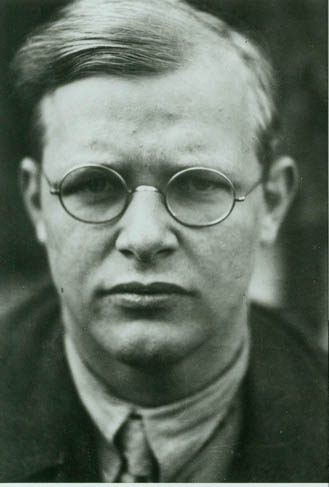 It seems that everyone is talking about Dietrich Bonhoeffer at the moment. Here are a few famous Bonhoeffer quotes I've found on the Internet.
On cheap grace
"Cheap grace means grace as a doctrine, a principle, a system. It means forgiveness of sins proclaimed as a general truth, the love of God taught as the Christian 'conception' of God. An intellectual assent to that idea is held to be of itself sufficient to secure remission of sins. The Church which holds the correct doctrine of grace has, it is supposed, ipso facto a part in that grace. In such a Church the world finds a cheap covering for its sins; no contrition is required, still less any real desire to be delivered from sin. Cheap grace therefore amounts to a denial of the living Word of God, in fact, a denial of the Incarnation of the Word of God." (emphasis added)
"Cheap grace means the justification of sin without the justification of the sinner. Grace alone does everything, they say, and so everything can remain as it was before."
"Cheap grace is grace without discipleship, grace without the cross, grace without Jesus Christ, living and incarnate."
On costly grace
"Costly grace is the treasure hidden in the field; for the sake of it a man will gladly go and sell all that he has... It is the kingly rule of Christ,..., it is the call of Jesus Christ at which the disciple leaves his nets and follows him."
"Such grace is costly because it calls us to follow, and it is grace because it calls us to follow Jesus Christ. It is costly because it costs a man his life, and it is grace because it gives a man the only true life. It is costly because it condemns sin, and grace because it justifies the sinner. Above all, it is costly because it cost God the life of his Son: 'ye were bought at a price,' and what has cost God much cannot be cheap for us. Above all, it is grace because God did not reckon his Son too dear a price to pay for our life, but delivered him up for us. Costly grace is the Incarnation of God."
"Such grace is costly because it calls us to follow, and it is grace because it calls us to follow Jesus Christ. It is costly because it costs a man his life, and it is grace because it gives a man the only true life. It is costly because it condemns sin, and grace because it justifies the sinner. Above all, it is costly because it cost God the life of his Son: 'ye were bought at a price,' and what has cost God much cannot be cheap for us. Above all, it is grace because God did not reckon his Son too dear a price to pay for our life, but delivered him up for us. Costly grace is the Incarnation of God."
"Costly grace confronts us as a gracious call to follow Jesus, it comes as a world of forgiveness to the broken spirit and the contrite heart. Grace is costly because it compels a man to submit to the yoke of Christ and follow him; it is grace because Jesus says: 'My yoke is easy and my burden is light.'"
Thursday, July 21, 2011
Some thoughts on mission (especially cross-cultural mission) - Part 1
Recently I have been thinking about my own view of mission. There are many who know much more than I, and so I don't think the following is new. But I feel that I need to formulate my view on mission in light of the Scripture and experience. Here are some initial thoughts.
Scripture
Much can be said here. But I will only mention the fact that Paul - the Jewish Christian - is an apostle to the Gentiles. In Romans we find that Paul envisions a Jew-Gentile love-centred community that seeks to follow Jesus. This community is in Christ through Jesus' atoning sacrifice, and seeks to embody Christ's self-giving life through the indwelling Holy Spirit. Paul sees this as God's saving purpose and his role is to proclaim this good news ("good news" is of course the meaning of the Greek word for "gospel") - first to the Jews, then to the Gentiles.
Christ's identification with humanity
The New Testament speaks of a God who sent his Son to our world. It talks about Christ's participation in frail humanity and suffered death as an atoning sacrifice for our sins (not least in Romans 8:3-4). There is a strong sense in which the followers of Jesus are to follow his way of self-giving life. The mission of God consists in him sending his Son to our world to accomplish his saving purpose. The vocation of his followers is to participate in his saving purpose by embodying Christ's way of life. In the context of cross-cultural mission, the messengers of the good news will do well if they enter the culture of their audience, live among them and remain there long-term, learn their language and participate in their sorrow and joy. Through this participatory approach, God's heralds of the gospel reflect God's character and love through their deeds and words. Through God's Spirit the gospel is proclaimed through his Presence in the Christ-followers.
Not everyone is called to engage in long-term cross-cultural mission. But we are all called to participate in God's saving purpose by embodying Christ's self-giving way of life in our own contexts and through our solidarity with those who engage in long-term cross-cultural mission.
(Click here for Part 2 on my thoughts on mission)
Scripture
Much can be said here. But I will only mention the fact that Paul - the Jewish Christian - is an apostle to the Gentiles. In Romans we find that Paul envisions a Jew-Gentile love-centred community that seeks to follow Jesus. This community is in Christ through Jesus' atoning sacrifice, and seeks to embody Christ's self-giving life through the indwelling Holy Spirit. Paul sees this as God's saving purpose and his role is to proclaim this good news ("good news" is of course the meaning of the Greek word for "gospel") - first to the Jews, then to the Gentiles.
Christ's identification with humanity
The New Testament speaks of a God who sent his Son to our world. It talks about Christ's participation in frail humanity and suffered death as an atoning sacrifice for our sins (not least in Romans 8:3-4). There is a strong sense in which the followers of Jesus are to follow his way of self-giving life. The mission of God consists in him sending his Son to our world to accomplish his saving purpose. The vocation of his followers is to participate in his saving purpose by embodying Christ's way of life. In the context of cross-cultural mission, the messengers of the good news will do well if they enter the culture of their audience, live among them and remain there long-term, learn their language and participate in their sorrow and joy. Through this participatory approach, God's heralds of the gospel reflect God's character and love through their deeds and words. Through God's Spirit the gospel is proclaimed through his Presence in the Christ-followers.
Not everyone is called to engage in long-term cross-cultural mission. But we are all called to participate in God's saving purpose by embodying Christ's self-giving way of life in our own contexts and through our solidarity with those who engage in long-term cross-cultural mission.
(Click here for Part 2 on my thoughts on mission)
Wednesday, July 20, 2011
Gordon Fee on Revelation 20:1-6 - "the thousand years"
Every now and then people would ask me about what the "thousand years" mean in Revelation 20:1-6. Here I will cite a few comments from Gordon Fee's commentary (Eugene: Cascade Books, 2011) to help us answer that. But first, here the NIV2011 version of the passage:
"And I saw an angel coming down out of heaven, having the key to the Abyss and holding in his hand a great chain. He seized the dragon, that ancient serpent, who is the devil, or Satan, and bound him for a thousand years. He threw him into the Abyss, and locked and sealed it over him, to keep him from deceiving the nations anymore until the thousand years were ended. After that, he must be set free for a short time. I saw thrones on which were seated those who had been given authority to judge. And
I saw the souls of those who had been beheaded because of their testimony about Jesus and because of the word of God. They had not worshiped the beast or its image and had not received its mark on their foreheads or their hands. They came to life and reigned with Christ a thousand years. (The rest of the dead did not come to life until the thousand years were ended.) This is the first resurrection. Blessed and holy are those who share in the first resurrection. The second death has no power over them, but they will be priests of God and of Christ and will reign with him for a thousand years."

Here are excerpts from Gordon Fee's commentary on Revelation.
As to the question of what is the role of this passage to the narrative as a whole, Fee says,
What then is the meaning of "after that, he must be set free for a short time" in Rev 20:3?
Here are some Fee's conclusion remarks on Rev 20:1-6.
"So John's apparent intent here is not to say something about them [ie. the martyrs], but to make sure that the reader recognizes that what is true for all believers is true for them in particular. That is, since all of God's redeemed people will experience the first resurrection, it is therefore also true that all of God's people are thereby 'blessed and holy' and will not experience the 'second death.' This, however, is especially true of the martyrs, about whom John then concludes, they will be priests of God and of Christ and will reign with him for a thousand years. Here again the reader can hardly miss the high Christology, in which the Father and Son are once more brought together at the Eschaton. What is noteworthy in this case is that the final pronoun 'him' is singular, therefore referring to Christ alone. Thus believers will serve as a kind of eternal priesthood before God and Christ, but the special privilege of the martyrs is that they 'reign' with Christ (alone) for the thousand-year period allotted especially to them. After all, according to the preceding sentence this privilege does not include 'the rest of the dead.'" (page 284)
"And I saw an angel coming down out of heaven, having the key to the Abyss and holding in his hand a great chain. He seized the dragon, that ancient serpent, who is the devil, or Satan, and bound him for a thousand years. He threw him into the Abyss, and locked and sealed it over him, to keep him from deceiving the nations anymore until the thousand years were ended. After that, he must be set free for a short time. I saw thrones on which were seated those who had been given authority to judge. And
I saw the souls of those who had been beheaded because of their testimony about Jesus and because of the word of God. They had not worshiped the beast or its image and had not received its mark on their foreheads or their hands. They came to life and reigned with Christ a thousand years. (The rest of the dead did not come to life until the thousand years were ended.) This is the first resurrection. Blessed and holy are those who share in the first resurrection. The second death has no power over them, but they will be priests of God and of Christ and will reign with him for a thousand years."

Here are excerpts from Gordon Fee's commentary on Revelation.
"[T]he two paragraphs, both of which begin yet again with the verb 'I saw,' are best understood together as an interlude between the divine overthrow of the unholy triumvirate (Satan, the Empire, the cult of the emperor) delineated in the preceding section (19:11-21), and the final judgement of all evil, both demonic and human, in 20:7-15. Again, as throughout, judgment itself is not the last word. So the book concludes in turn with 'a new heaven and a new earth' (21:1-8), and a 'new Jerusalem' (21:2, 9-26), which evolves into a restored Eden (22:1-5)!" (page 280)
As to the question of what is the role of this passage to the narrative as a whole, Fee says,
"[S]ince Jewish apocalypses (after Daniel) regularly have such a moment in them, although this is the only instance of 'a thousand years' as such. Millennial ideas, for example, can be found in 2 Baruch 29-30 and the Psalms of Solomon 17; but neither of these specify a thousand-year time period, rather they look forward to a time of messianic bliss on earth. However, in neither of these cases is there also a final 'heavenly' existence as well. Thus, whatever millennial ideas may have preceded John, the present passage is remarkably his own, and has specifically to do with the special place Christian martyrs have in the divine economy." (page 282)
What then is the meaning of "after that, he must be set free for a short time" in Rev 20:3?
"[It] is mostly likely related to ... that John's major concern here is not with time as such, but with the special place God has reserved for those who have been killed by the state simply because they were followers of the once slain, now risen Lamb. In any case, John's obvious concern lies with the second paragraph (vv. 4-6), and thus not with the time period as such. The picture itself is ultimately about the role of the martyrs during the thousand-year period. And even though there is no specific geographical location given, John seems clearly to have planet earth still in view. This is made certain by the language about 'the nations' in verse 3 and the picture of the resurrected martyrs 'reigning' with Christ, plus the reality that it is literally sandwiched between the Last Battle in 19:11-21 and the release of Satan to 'deceive the nations' in 20:7-10." (page 282)
Here are some Fee's conclusion remarks on Rev 20:1-6.
"So John's apparent intent here is not to say something about them [ie. the martyrs], but to make sure that the reader recognizes that what is true for all believers is true for them in particular. That is, since all of God's redeemed people will experience the first resurrection, it is therefore also true that all of God's people are thereby 'blessed and holy' and will not experience the 'second death.' This, however, is especially true of the martyrs, about whom John then concludes, they will be priests of God and of Christ and will reign with him for a thousand years. Here again the reader can hardly miss the high Christology, in which the Father and Son are once more brought together at the Eschaton. What is noteworthy in this case is that the final pronoun 'him' is singular, therefore referring to Christ alone. Thus believers will serve as a kind of eternal priesthood before God and Christ, but the special privilege of the martyrs is that they 'reign' with Christ (alone) for the thousand-year period allotted especially to them. After all, according to the preceding sentence this privilege does not include 'the rest of the dead.'" (page 284)
Tuesday, July 12, 2011
My new article: The gulf between us and the poor
ETHOS at the Australian Evangelical Alliance has published my article entitled The Gulf Between Us and the Poor.
Here is the heading provided by their editor.
"The gulf between the rich and the poor is not simply an economical one. While the poor do not have moral superiority over the rich, and at least in theory our material affluence should not adversely affect our ability to understand the Bible, is our wealth a hindrance that stops us from fully understanding the plight of the poor and the Scripture?"
There is a great cartoon in the article. Have a look!
Click here for the full article.
Here is the heading provided by their editor.
"The gulf between the rich and the poor is not simply an economical one. While the poor do not have moral superiority over the rich, and at least in theory our material affluence should not adversely affect our ability to understand the Bible, is our wealth a hindrance that stops us from fully understanding the plight of the poor and the Scripture?"
There is a great cartoon in the article. Have a look!
Click here for the full article.
Sunday, July 10, 2011
Reflection: Two recent movies, discipleship, justice for the oppressed
Two recent movies reflect elements of what I have been thinking in my studies and in my work in an overseas aid and development Christian organisation. Of course different people have different takes on the movies. But here are my reflections.

(1) Movie: Of Gods and Men
Based on a true story, this movie is about the choices made by a group of monks in a monastery in Algeria when their lives were threatened. I think true discipleship is ultimately about following Christ's sacrificial way of life, which is expressed in our solidarity with the community, not least those who are vulnerable and powerless. This is no abstract theology or theory, but a call to be authentic followers of Jesus.
Click here for a review from Guardian, UK.
(2) Movie: Oranges and Sunshine
 This movie is based on true events that happened in the 1950s and 1960s, in which thousands of children were transported to Australia from England wrongfully. I think this movies highlights the fact that we need to recognise the fact that injustice and oppression is often embedded in a web of systemic social and individual sins. There are political, social and even religious systems and structures that oppress the vulnerable in our world. We need to stand in solidarity with those who suffer from injustice because of their powerlessness. Unfortunately Christians often are unaware of this, despite the fact that the Bible speaks of this in the Prophets (not least Isaiah, Amos, Micah, Jeremiah, Zechariah) and in Jesus' own ministry.
Click here for a review from ABC At the Movies.
Putting the above two reflections together, I think the church is called to participate in Christ's life, suffering, death and resurrection, just as he participated in human frailty in order to accomplish his atoning sacrifice for our sins and his redemption for his entire creation. We are to proclaim this Christ to all humankind - through our words and daily life - so that people may have hope and shalom through faith in Christ Jesus.
(1) Movie: Of Gods and Men
Based on a true story, this movie is about the choices made by a group of monks in a monastery in Algeria when their lives were threatened. I think true discipleship is ultimately about following Christ's sacrificial way of life, which is expressed in our solidarity with the community, not least those who are vulnerable and powerless. This is no abstract theology or theory, but a call to be authentic followers of Jesus.
Click here for a review from Guardian, UK.
(2) Movie: Oranges and Sunshine
This movie is based on true events that happened in the 1950s and 1960s, in which thousands of children were transported to Australia from England wrongfully. I think this movies highlights the fact that we need to recognise the fact that injustice and oppression is often embedded in a web of systemic social and individual sins. There are political, social and even religious systems and structures that oppress the vulnerable in our world. We need to stand in solidarity with those who suffer from injustice because of their powerlessness. Unfortunately Christians often are unaware of this, despite the fact that the Bible speaks of this in the Prophets (not least Isaiah, Amos, Micah, Jeremiah, Zechariah) and in Jesus' own ministry.Click here for a review from ABC At the Movies.
Putting the above two reflections together, I think the church is called to participate in Christ's life, suffering, death and resurrection, just as he participated in human frailty in order to accomplish his atoning sacrifice for our sins and his redemption for his entire creation. We are to proclaim this Christ to all humankind - through our words and daily life - so that people may have hope and shalom through faith in Christ Jesus.
Saturday, July 9, 2011
Proclaiming and living out the resurrection of the crucified Christ (Michael Pahl)
I just finished reading Michael W Pahl's little book called From Resurrection to New Creation (Eugene: Cascade Books, 2010). In the following I will cite three quotes in the last chapter that are very helpful (on page 94).
 The first two quotes probably require reading the book itself before one can fully grasp their significance, although they shouldn't be too hard to understand. The last quote shows how in practice the church can carry out its task of proclaiming and embodying Christ in this age.
In many ways this has been what I have been trying to say in the past five years at theological colleges and churches.
"Yet another way to see this creation renewal task is to understand it as applying the resurrection reversal of the crucified Jesus to the world around us. In Jesus' resurrection, condemnation, shame, oppression, and death have been transformed into vindication, glory, freedom, and life. Thus, by the Spirit of Jesus the church is called to bring restorative care to the earth, liberating justice to the oppressed, food to the hungry, comfort to the suffering, healing to the sick, forgiveness and honor to the guilty and shamed, love to those in need, faith to those who doubt, hope to those in despair - light and life to a dark and dying world. This resurrection reversal is both our salvation and blessing and our missionary task."
The way I myself would like to frame this is through the stories in the Bible, the stories of the people of God, as well as the stories of the poor and oppressed. Through the biblical narratives we discover the story of the suffering, death and resurrection of Christ, as well as the stories of God's people (those of Israel and the Christ-community). As we enter the biblical stories we learn to appropriate those stories in our own lives and in the world. That's how we may proclaim and embody the gospel in a world out-of-joint.
In many ways this has been what I have been trying to say in the past five years at theological colleges and churches.
"Proclaiming and living out the death and resurrection of Jesus in faith, hope, and love, as described above, the church is called to enact God's program of creation renewal in this age in anticipation of the fulfillment of the renewal of creation in the age to come."
"Another way to look at this task of creation renewal is to see it as simply fulfilling the purpose of humanity in the image of God, ensuring and extending God's loving and faithful rule throughout the earthly creation."
"Yet another way to see this creation renewal task is to understand it as applying the resurrection reversal of the crucified Jesus to the world around us. In Jesus' resurrection, condemnation, shame, oppression, and death have been transformed into vindication, glory, freedom, and life. Thus, by the Spirit of Jesus the church is called to bring restorative care to the earth, liberating justice to the oppressed, food to the hungry, comfort to the suffering, healing to the sick, forgiveness and honor to the guilty and shamed, love to those in need, faith to those who doubt, hope to those in despair - light and life to a dark and dying world. This resurrection reversal is both our salvation and blessing and our missionary task."
The way I myself would like to frame this is through the stories in the Bible, the stories of the people of God, as well as the stories of the poor and oppressed. Through the biblical narratives we discover the story of the suffering, death and resurrection of Christ, as well as the stories of God's people (those of Israel and the Christ-community). As we enter the biblical stories we learn to appropriate those stories in our own lives and in the world. That's how we may proclaim and embody the gospel in a world out-of-joint.
N. Clayton Croy on th incarnation and the resurrection of Christ
I found the following written by N. Clayton Croy's from the website of the seminary where he works as a professor. It is about the incarnation and the resurrection.
"The twin theological themes of incarnation and resurrection are especially interesting to me. The former is God's resounding affirmation of embodied life; the latter assures us that such life is not a temporary aberration. Resurrection is God's way of saying that embodied human beings are too good an idea to have a shelf life."
Click here for the web link from which I found this quote today.
"The twin theological themes of incarnation and resurrection are especially interesting to me. The former is God's resounding affirmation of embodied life; the latter assures us that such life is not a temporary aberration. Resurrection is God's way of saying that embodied human beings are too good an idea to have a shelf life."
Click here for the web link from which I found this quote today.
Saturday, July 2, 2011
Timothy Gombis on "God's Missional Sustenance for God's people"
Timothy Gombis has posted something really nice in his blog. It's his reflection after a number of posts on John 4. It ends with Gombis' own experience in his church. For years I have been thinking about what the Christian community should be like, and I am really glad to find that Gombis is saying something very similar to what I have in mind (and he articulates it so much better). Here are some excerpts from his blog post.
"First, we do not encounter the other—or, the world—with a posture of condescension, arrogance, or even in order to set anyone right. Just as Jesus asked the woman for a drink, taking on a posture of mutuality and even need, we ought to cultivate friendships and relationships of mutuality with others."
"Churches can offer to clean up local neighborhoods, care for town parks, staff after-school services for kids from low-income homes,... And we can serve the world in these ways with no interest in “the bottom line,” but simply with hopes of faithfully embodying our identity as followers of Jesus."
Click here for the original blog post.
"I’ve been thinking about this in relation to divine election as the identity of the people of God. So often we shrink back from this notion because it seems to imply an “insiders only” mentality. “We’re God’s elect and they aren’t.” We may have seen a doctrine of election put to use to endorse a lack of redemptive involvement in the wider culture."
"Jesus indicates, however, that it is only when the church encounters outsiders in open-ended relationships that we are sustained."
"First, we do not encounter the other—or, the world—with a posture of condescension, arrogance, or even in order to set anyone right. Just as Jesus asked the woman for a drink, taking on a posture of mutuality and even need, we ought to cultivate friendships and relationships of mutuality with others."
"There are countless ways that churches can relate to outsiders and to surrounding culture(s) that follow the pattern of Jesus, but so many of these are unexplored. We tend only to imagine manipulative relationships, ones that will “get results.”"
"Churches can offer to clean up local neighborhoods, care for town parks, staff after-school services for kids from low-income homes,... And we can serve the world in these ways with no interest in “the bottom line,” but simply with hopes of faithfully embodying our identity as followers of Jesus."
"We tend to imagine that we need to have all the right tools, get all the right teaching, and only then do we go out and get involved in our communities. I wonder if we think this way because we want to have some sort of guarantee that we’ll get results. Or, maybe to pacify our fear of failure."
"About a year into our urban missional church experience, I was walking with my friend John Mortensen in our church’s local neighborhood. We had imagined that God was going to do amazing things through our church. After all, we were sent there as their salvation. Or so we imagined."
"The on-the-ground realities slowly dissolved our romantic notions and our big dreams. Rather than seeing lots of change in the neighborhood, we began seeing changes in ourselves. That conversation made all of this make sense to me. John and I came to the realization that we weren’t the salvation of that neighborhood. God had us there in that neighborhood to save us."
"God was sustaining us and giving us life as we enjoyed conversations with people over a meal, as we shared about our lives and listened to their stories, and as we developed friendships of giving and receiving."
Click here for the original blog post.
Wednesday, June 29, 2011
Some good quotes about the poor, the Bible, faith and discipleship (Fee, Gombis, Pahl, Barth, Willitts)
(3) "God is as much present in the scientifically and historically explainable as he is in that which has not yet been explained. Nor should we expect to see God only in the "miraculous," or in the triumphs of life. God is as much present in the mundane and in life's tragedies as he is in those experiences which are typically seen as the more likely demonstrations of divine activity." Michael Pahl, From the Resurrection to New Creation (Eugene: Cascade, 2010), page 70.
(4) Two quotes of Dietrich Bonhoeffer (via Joel Willitts)
True believers must participate in the suffering of Christ. This call to self-denial and suffering is the “hard word of grace”. "Just as Christ is only Christ as one who suffers and is rejected, so a disciple is a disciple only in suffering and being rejected, thereby participating in crucifixion." "Suffering becomes the identifying mark of a follower of Christ." (Dietrich Bonhoeffer via Joel Willitts) (Click here for Willitts' post)
"The call to discipleship is a commitment solely to the person of Jesus . . . It is beyond enmity between law and gospel. Christ calls; the disciple follows. That is grace and commandment in one." (Bonhoeffer via Joel Willitts)
(5) "The social dynamics of celebrity culture are now so familiar that they no longer shock us... I... have thought often about the social and cultural forces that tempt us to focus on image-maintenance. These dynamics make us inauthentic and lead to shallow and manipulative relationships. Because we want others to be impressed with us, we’re tempted to craft public images that mask our failures and weaknesses and trumpet our strengths." Tim Gombis - Click here for Gombis' blog post.
(6) Quotes of Karl Barth (via Tim Gombis)
“God can be known only when those of the highest rank regard suffering with the whole social order of their age and bearing its heavy burden as the noblest achievement of which they are capable; when the rich in spirit think nothing of their wealth—not even in order to share it—but themselves become poor and the brothers of the poor..." (Karl Barth via Tim Gombis - Click here for Gombis' blog post)
A paradox of the cruciform God: “God gives life only through death.” (Karl Barth via Tim Gombis - click here for Gombis' blog post)
A paradox of the cross: “The cross is the bridge which creates a chasm and the promise which sounds a warning” (Karl Barth via Tim Gombis - click here for Gombis' blog post)
(7) "I am because we are, since we are, therefore I am." (John S Mbiti, African scholar) No individualistic religion there.
Tuesday, June 28, 2011
On prayer: Some good points by Nijay Gupta
Nijay Gupta has posted some good stuff on his blog. It's in response to Daniel Kirk. I haven't read Kirk's posts on this matter. But in and of themselves Nijay Gupta's points are worth reading.
Click here for the post.
Click here for the post.
Monday, June 27, 2011
Joel Willitts' reviews on Rob Bell's Love Wins
Click here for Part 3 of Joel Willitts' review on Rob Bell's Love Wins.
Click here for Part 4 of Joel Willitts' review on Rob Bell's Love Wins.
Click here for Part 5 of Joel Willitts' review on Rob Bell's Love Wins.
I did not follow up on the other reviews done by Joel Willitts in his blog. But fortunately he recently (22nd June 2011) provided a document with all the blog reviews he posted . Click here for the blog post that has this document.
Click here for other reviews/discussions.
Click here for Part 4 of Joel Willitts' review on Rob Bell's Love Wins.
Click here for Part 5 of Joel Willitts' review on Rob Bell's Love Wins.
I did not follow up on the other reviews done by Joel Willitts in his blog. But fortunately he recently (22nd June 2011) provided a document with all the blog reviews he posted . Click here for the blog post that has this document.
Click here for other reviews/discussions.
Reflection: Sin, grace, salvation and our attitude toward others
Just a few thoughts.
For if we realise how sinful we are we would not claim that we are always right, or more righteous than others. Likewise, if we truly realise how sinful we are and hence how amazing God's grace is for us, we would see our fellow human beings as fellow sinners who need God's grace (rather than "them as sinners" and "us as righteous people").
All these come back to how much we truly understand "salvation by grace", or, more precisely, "salvation by the costly grace" of the Crucified Christ and Risen Lord.
And as I wrote the above, I wonder how much I have fallen short of God's glory, and how thankful I am to God who has poured out his grace on me, a sinner.
Perhaps our reluctance to say sorry to others (for big and small matters alike) is a reflection of our lack of understanding of our own sinfulness - the very human condition that shows us how much we need God's grace.
Perhaps our tendency to see the faults, shortcomings and sins of others (rather than the good in them) is a reflection of our lack of understanding of God's sheer grace in rescuing us from the bondage of sin and death through Christ Jesus our Lord.
For if we realise how sinful we are we would not claim that we are always right, or more righteous than others. Likewise, if we truly realise how sinful we are and hence how amazing God's grace is for us, we would see our fellow human beings as fellow sinners who need God's grace (rather than "them as sinners" and "us as righteous people").
All these come back to how much we truly understand "salvation by grace", or, more precisely, "salvation by the costly grace" of the Crucified Christ and Risen Lord.
And as I wrote the above, I wonder how much I have fallen short of God's glory, and how thankful I am to God who has poured out his grace on me, a sinner.
Monday, June 13, 2011
Some good quotes from Karl Barth's commentary on Romans (via Tim Gombis)
Tim Gombis just posted some good stuff from Barth's commentary on Romans.
I often think that it is our reluctance to accept that there are paradoxes and tensions in Paul's letters that we end up twisting the apostle's words to suit our theology. But in accepting those tensions we find profound truths that are life giving. The paradox of the cruciform God above is a good example.
Click here for Gombis' post.
"A paradox of the cruciform God: “God gives life only through death” (p. 105).
A paradox of the cross: “The cross is the bridge which creates a chasm and the promise which sounds a warning” (p. 112)."
I often think that it is our reluctance to accept that there are paradoxes and tensions in Paul's letters that we end up twisting the apostle's words to suit our theology. But in accepting those tensions we find profound truths that are life giving. The paradox of the cruciform God above is a good example.
Click here for Gombis' post.
Wednesday, June 8, 2011
Paul wrote to the poor people in Rome (Tom Wright on Romans)
 In N T (Tom) Wright's Paul for Everyone - Romans Part 1, he aptly describes the type of people his audience would consist of. I think this provides useful information for us to understand Paul's letter to the Romans, and what the gospel (literally means "good news") means for Paul's audience.
 "In ancient Rome as today, of course, the rich people lived up in the hills, the famous seven hills on which the city stands. The original imperial palace, where the Emperor Augustus lived at the time when Jesus was born, occupies most of one of them. Nero was emperor when Paul was writing this letter; his spectacular palace is on another hill, the other side of the Forum. But then as now the poorer people lived in the areas around the river; not least, in the area just across the river from the main city centre. And that is where most of the first Roman Christians lived. The chances are that the first time this great letter was read aloud it was in a crowded room in someone's house in the low-lying poorer district, just across the river from the seat of power." (page 6; emphasis added)
Saturday, June 4, 2011
Economic profile of the earliest Christians - Urban Jesus-followers in Paul's letters (Bruce Longenecker)
In his new book Remember the Poor (2010), Bruce Longenecker provides a picture of the economic profile of a typical urban group of Jesus-followers in the days of the New Testament.

Longenecker emphasizes that the following figures are only rough estimates. But it seems that he has done extensive research on this and there are good reasons to use them as fairly reliable background information when it comes to interpreting Paul's letters in the New Testament.
Here is what he says,
3. Roughly 65% of this community is marked out by subsistence-level existence (ES6 to ES7)."
It is clear that the majority of the Christ-community in Paul's house churches lived below, at, or near subsistence level. This, I think, means that we should read Paul's letters in light of this important background.
For example, when we see the words "suffering" or "affliction" in Paul's letters, at least one aspect of these words would be related to socioeconomic hardships from the audience's perspective (unless the context clearly says otherwise).
Also, financial generosity in Paul is not so much about the wealthy giving to the destitute. Rather, it is about sharing the scarce resources available in the community. That is, it is about the relatively "less poor" Christians sharing their resource with the poorest among them.

Longenecker emphasizes that the following figures are only rough estimates. But it seems that he has done extensive research on this and there are good reasons to use them as fairly reliable background information when it comes to interpreting Paul's letters in the New Testament.
Here is what he says,
"1. Roughly 10% of this community is among the middling groups of Roman urbanism (ES4), not without economic risk, but also with a relatively significant level of economic security...
2. Roughly 25% of this community has some minimal economic resources (ES5)...
It is clear that the majority of the Christ-community in Paul's house churches lived below, at, or near subsistence level. This, I think, means that we should read Paul's letters in light of this important background.
For example, when we see the words "suffering" or "affliction" in Paul's letters, at least one aspect of these words would be related to socioeconomic hardships from the audience's perspective (unless the context clearly says otherwise).
Also, financial generosity in Paul is not so much about the wealthy giving to the destitute. Rather, it is about sharing the scarce resources available in the community. That is, it is about the relatively "less poor" Christians sharing their resource with the poorest among them.
Some quotes in Walter Hansen's commentary on Philippians (from Mike Bird's blog)
In one of his latest posts Mike Bird has cited some good stuff in Walter Hansen's commentary on Philippians. Here are two of those quotes.
 "One of the biggest highlights of the book is the discussions on “The Gospel of Christ” (pp. 31-32). Hansen writes: “The content of the gospel is the good news that Jesus Christ is Lord. Pulsating with praise for the humility and exaltation of the Lord Jesus Christ, the Christ hymn (2:6-11) is the heart of the letter … Living according to the gospel is a process of pressing on to apprehend the surpassing worth of Jesus Christ and being apprehended him him (3:12). Progress in the Christian life is not measured by ‘righteousness based on the law’; instead, it begins with the gift of ‘righteousness that comes from God through faith in Christ’ (3:6-9).”"
Click here for more from Mike Bird's post.
 "One of the biggest highlights of the book is the discussions on “The Gospel of Christ” (pp. 31-32). Hansen writes: “The content of the gospel is the good news that Jesus Christ is Lord. Pulsating with praise for the humility and exaltation of the Lord Jesus Christ, the Christ hymn (2:6-11) is the heart of the letter … Living according to the gospel is a process of pressing on to apprehend the surpassing worth of Jesus Christ and being apprehended him him (3:12). Progress in the Christian life is not measured by ‘righteousness based on the law’; instead, it begins with the gift of ‘righteousness that comes from God through faith in Christ’ (3:6-9).”"
"Enjoyable also is the discussion of the meaning of union with Christ (pp. 87-90). Hansen writes: “When he looked at the cross of Christ, Paul thought, ‘That is my destiny! As Christ embraced the cross in humble obedience to God, so I desire to embrace my death as a witness to my union with Christ.”"
Click here for more from Mike Bird's post.
Wednesday, June 1, 2011
The resurrection as missional paradigm - An Indian perspective
From Michael Gorman's blog he points us to something an Indian New Testament scholar says about the resurrection being a paradigm for mission.
Here is what he says,
"The significance of the resurrection of Jesus in my Indian context is multi-faceted. When I’m talking about the resurrection of Jesus in our multi-religious, multi-cultural and pluralistic culture of India, I have to re-interpret the significance of Christ’s resurrection for our diverse communities. The salvific significance of Christ’s work on the cross, and his resurrection should first and foremost be taught and proclaimed, as the good news of salvation for the various religious and ethnic communities. As a second order to this, when I am witnessing Christ for instance to the Dalits, Tribals and the Adivasis (the poor and marginalized, also called the dust of the dust), I use Christ’s resurrection as a model for liberation out of the clutches of oppression and dehumanization. As Christ was humiliated on the cross, and was raised by the Father from the grave, so also, Christian mission should focus on the upliftment of the oppressed out of the bondages of poverty, casteism, sin and injustice."
Click here for Gorman's post.
Here is what he says,
Click here for Gorman's post.
Gordon Fee: A professor on fire (filled with the Spirit)
In the Charisma magazine there is an article on Professor Gordon Fee, who is one of the most respected New Testament scholars today. I like Gordon Fee because he endeavours to read the Scripture on its own terms, rather than through the lens of a particular theology. I still find his commentaries and books most helpful.
 Here are some excerpts from the article.
Click here for the article.
"Gordon Fee knows how it feels to be a lone ranger. Regarded as the first Bible scholar of the modern Pentecostal movement, Fee is a maverick. For 40 years he has fought an uphill battle in Pentecostal circles, within a movement that has been traditionally wary of theological endeavors and has placed far stronger emphasis on spiritual experience. "
"Yet his insights into the apostle Paul’s teachings have influenced thousands of believers. And his writings have opened up the New Testament for Christians across the theological span."
"As he pursued opportunities to teach and write, his reputation as an independent thinker and New Testament scholar grew quickly. Many Bible scholars, Fee says, write books to fit their theology. He strives to plumb the Scriptures without a preconceived Pentecostal bent, an approach known as exegesis in scholarly terms."
"“I don’t think of myself as a Pentecostal scholar,” says Fee, who today holds a dual U.S.-Canadian citizenship and lives in Vancouver, Canada. “I think of myself as a scholar who happens to be a lifelong Pentecostal.”"
Click here for the article.
Scripture, God's authority and his mission (Scot McKnight on Tom Wright's book)

Two excerpts from McKnight's post.
"The expression “authority of Scripture” is shorthand for “the authority of the triune God, exercised somehow through Scripture” (21). There is something important here, for Wright acknowledges that authority is God’s — and derivatively of Scripture. Any time someone equates the two, there opens the possibility for idolatry to occur. Furthermore, Wright is keen on showing that this authority of God is God’s authority in working out the Kingdom mission for his people and creation. Scripture, then, is a sub-branch of mission, the Spirit, eschatology, and the Church itself (29). Again, very important."
"When Wright comes to sum up his entire argument, on pp. 115-116, he says this: The authority of Scripture is “a picture of God’s sovereign and saving plan for the entire cosmos, dramatically inaugurated by Jesus himself, and now to be implemented through the Spirit-led life of the church precisely as the scripture-reading community.” Thus, the “authority of Scripture” is put into action in the Church’s missional operations. Scripture, he says, is more than a record of revelation and was never simply about imparting information — it is God’s word to redeem his people as God works out his plan for the entire created order. And you may know how the Bible teaches what Tom calls a 5-Act play: creation, fall, Israel, Jesus, Church. We are in the 5th Act now."
It is a book worth reading.
Click here for McKnight's post.
Saturday, May 28, 2011
A majestic prayer
I pray that, according to the riches of his glory, he may grant that you may be strengthened in your inner being with power through his Spirit, and that Christ may dwell in your hearts through faith, as you are being rooted and grounded in love. I pray that you may have the power to comprehend, with all the saints, what is the breadth and length and height and depth, and to know the love of Christ that surpasses knowledge, so that you may be filled with all the fullness of God. (Ephesians 3:16-19; NRSV)
Ephesians 3:16 ἵνα δῷ ὑμῖν κατὰ τὸ πλοῦτος τῆς δόξης αὐτοῦ δυνάμει κραταιωθῆναι διὰ τοῦ πνεύματος αὐτοῦ εἰς τὸν ἔσω ἄνθρωπον, 3:17 κατοικῆσαι τὸν Χριστὸν διὰ τῆς πίστεως ἐν ταῖς καρδίαις ὑμῶν, ἐν ἀγάπῃ ἐρριζωμένοι καὶ τεθεμελιωμένοι, 3:18 ἵνα ἐξισχύσητε καταλαβέσθαι σὺν πᾶσιν τοῖς ἁγίοις τί τὸ πλάτος καὶ μῆκος καὶ ὕψος καὶ βάθος, 3:19 γνῶναί τε τὴν ὑπερβάλλουσαν τῆς γνώσεως ἀγάπην τοῦ Χριστοῦ, ἵνα πληρωθῆτε εἰς πᾶν τὸ πλήρωμα τοῦ θεοῦ.
Thursday, May 26, 2011
Something from C Kavin Rowe's World Upside Down

The title of chapter 2 is "Collision: Explicating Divine Identity". It examines the following:
Acts 14: Paul and Barnabas - Hermes and Zeus
Acts 16: Power at Philippi
Acts 17: Athens
Acts 19: Ephesus
I think it is a fascinating chapter. It talks about the collision between Christianity and Paul's audience in different cities. Here are some excerpts from the conclusion of the chapter (on pages 50, 51).
"This collision, however, is not due to the missionaries' lack of tact (though they were doubtless bold) or to a pagan propensity for rash violence...; rather, its deeper basis rests ultimately in the theological affirmation of the break between God and the cosmos. For to affirm that God has 'created heaven and earth' is, in Luke's narrative, simultaneously to name the entire complex of pagan religiousness as idolatry and, thus, to assign to such religiousness the character of ignorance."
"In short, religion and culture are inseparable, and the difference in the perception of divine identity amounts to nothing less than a different way of life."
To me, this last sentence says a lot. To be followers of Jesus is about a different way of life. We can't speak of "believing in Jesus" without following his way of life - a new culture and a new way of living that centres around Christ and the cross. I think the above from Rowe's book has several other implications to the church today.
- Do we engage in mission as if culture and religion are inseparable? If we do, then we can't be effective. Indeed we can make a lot of mistakes.
- What is the relationship between our faith and our own culture? Does our faith transform the culture in which we live? Or is our faith actually influenced by the culture of the world so much so that the world cannot see any difference between us and them? (For example, are we just as materialistic and the world in affluent West?)
Michael Bird on the cross - death and resurrection of Christ
Michael Bird's recent post is well written. Here are some excerpts.
"We have to remember, that cross and resurrection are an indissoluable unity. The cross without the resurrection is just martyrdom, at the most an act of solidarity with the persecuted nation, and at worst a wrongly calculate disaster. Conversely, the resurrection without the cross is a miraculous intrusion into history, a redemptive-historical enigma, and a paranormal freak show with indeterminable significance. But together the cross and resurrection constitute the fulcrum upon which God’s intention to repossess the world for himself is launched and enacted."
Click here for Mike Bird's post. (I would like to add that without death there is no resurrection. Both the death and resurrection are important. In fact, his life is also important to our Christian life and faith.)
"David Bebbington noted that in the nineteenth interdenominational newspaper the The British Weekly the most frequently preached text was Gal 2:20, “I have been crucified with Christ and I no longer life, but Christ lives in me. The life I life in the body, I live by faith in the Son of God, who loved me and gave himself for me”."
"Christian discipleship is cruciformity, being conformed to the pattern of the cross, dying to self in service to God. That is is what it means to take up your cross and follow Jesus daily (Luke 9:23) and to be crucified to the world (Gal 6:14)."
Click here for Mike Bird's post. (I would like to add that without death there is no resurrection. Both the death and resurrection are important. In fact, his life is also important to our Christian life and faith.)
Wednesday, May 18, 2011
Nijay Gupta's review on Love Wins
Nijay K Gupta has written a review on Rob Bell's Love Wins.
Here is part of his introduction:
Gupta discusses the book under the headings of The Good, The Bad, and The Ugly.
Click here for the post in his blog.
Click here for the full script.
Here is part of his introduction:
"Before we get started, I wanted to quickly comment on how Christians, and evangelicals in particular, should approach a controversial book. Because so many things were said to condemn Bell and his book even before it was released, we can see a dangerous trend among conservatives of a shoot-first-and-ask-questions-later technique. This raises the question: are we (Christians, and I am talking to my fellow evangelicals in particular) a teachable people? Sure, we have convinctions [sic]. We can draw a line and say: this is what I believe and what is outside of that I don’t believe. However, I think we (evangelicals) often cross over into the dangerous realm of only accepting inside scholars and, when we do happen to engage in dialogue with outsiders (be they Catholics, agnostics, Orthodox, etc.), we only do so trying to gain more converts to our perspective. The danger in this framework is that we lose a sense of humility and shared recognition that while we have convictions, we still have much to learn, and especially from each other.
That does not mean that you accept any and every teaching that comes your way, but you say to yourself: maybe I have something (even if something very small) to learn from a fellow human being who has worked hard (presumably) to comment in a fruitful way on an important subject..."
Gupta discusses the book under the headings of The Good, The Bad, and The Ugly.
Click here for the post in his blog.
Click here for the full script.
Sunday, May 8, 2011
Scot McKnight on the Beatitudes in Luke 6:20-26 (and Luke 4:16-21)

McKnight makes the following comments on the latter passage.
"Imagine what it would have been like for a poor Galilean to hear these words, and then imagine what it would have been like to be a rich Galilean and hear these words. The first group's chests were swelling as the second group's blood pressure was rising." (page 65)
Every time I read these words of Jesus I wonder which side I'm on. Am I with the poor or with the rich? I think Jesus wants us to feel that tension. He came, as he announced in his first sermon, for the poor and for the hungry and for those who weep and for those who are persecuted; and he came against the rich and against the well fed and against those who laugh now and against those who are popular. This is why he blesses the poor and offers only 'woes' to the rich." (page 66; emphasis original)
Don't think that McKnight's words are too strong. Read Luke 6:20-26 and you will find that his comments are fair.
Wednesday, April 27, 2011
Movie: Of Gods and Men
Tuesday, April 26, 2011
The resurrection of Christ as God's reign and in real life (Michael Gorman)
Michael Gorman has written a short reflection on the resurrection at Easter, which is not only relevant at Easter but the entire year.
Gorman begins with this:
"Today, of course, is Easter. In my experience, there are two types of Easter sermons: those that are primarily soteriological–what Christ’s resurrection means for us–and those that are primarily Christological–what Christ’s resurrection means for Christ. The latter type is also the rarer, and the former tends to be rather lightweight, theologically speaking.
Click here for the full post in Michael Gorman's blog.
Gorman begins with this:
"Today, of course, is Easter. In my experience, there are two types of Easter sermons: those that are primarily soteriological–what Christ’s resurrection means for us–and those that are primarily Christological–what Christ’s resurrection means for Christ. The latter type is also the rarer, and the former tends to be rather lightweight, theologically speaking.
I would naturally tend to prefer the more theological, the Christological, but of course Christology cannot be separated from soteriology. Easter is is not about us, first of all, but is about us, finally, and about God’s entire creation."
Gorman then shares some real life examples, as well as some good stuff from Tom Wright.
Social justice and mission (Centre for Applied Christian Ethics (CACE), Ridley College)
Last year I had the privilege of writing a paper to respond to three speakers at a theological forum at Tabor College on the topic Social Justice and the Mission of the Church.
The speakers were
Michael Raiter, Principal of Melbourne School of Theology (formerly Bible College of Victoria)
Deborah Storie, Chair of TEAR Australia
Steve Bradbury, Director of Micah 6:8 Centre, Tabor College
Click here for the papers.
The speakers were
Michael Raiter, Principal of Melbourne School of Theology (formerly Bible College of Victoria)
Deborah Storie, Chair of TEAR Australia
Steve Bradbury, Director of Micah 6:8 Centre, Tabor College
Click here for the papers.
Sunday, April 24, 2011
Embody God's victory (Timothy Gombis)
I am enjoying Timothy Gombis' The Drama of Ephesians (2010). Here is something that can help us understand how to embody Christ' triumph over evil in our daily life (which is perhaps very relevant during Easter but certainly relevant throughout the year).
"A prisoner has lost his freedom and is under the domination of the state... According to the first-century logic, if Paul is in a Roman prison, then the gods of Rome are stronger than the God whom Paul serves. So, why is Paul under the thumb of the powers that Christ has already vanquished?..." (p 109)
"So Paul gives them an apocalyptic interpretation of his apostleship and imprisonment. This is a heavenly vision of his life and ministry focusing especially on how it makes perfect sense that he is in prison... Paul's strategy is to situate his present circumstances squarely within the biblical tradition of God's power being demonstrated in human weakness. He does this by emphasizing the paradox of his life and ministry - at the same time that he occupies this terribly shameful and utterly weak situation as a prisoner, he fulfills a cosmically crucial commission as the administrator of the grace of God. In so doing, Paul wonderfully performs the same paradox as God's victory in Christ. Jesus Christ conquered the powers and authorities through his shameful and humiliating death on a Roman cross. because of God's upside-down logic, performances of God's triumph will inevitably involve displays of God's power through human weakness, loss, shame and humiliation." (p 110)
"A prisoner has lost his freedom and is under the domination of the state... According to the first-century logic, if Paul is in a Roman prison, then the gods of Rome are stronger than the God whom Paul serves. So, why is Paul under the thumb of the powers that Christ has already vanquished?..." (p 109)
"So Paul gives them an apocalyptic interpretation of his apostleship and imprisonment. This is a heavenly vision of his life and ministry focusing especially on how it makes perfect sense that he is in prison... Paul's strategy is to situate his present circumstances squarely within the biblical tradition of God's power being demonstrated in human weakness. He does this by emphasizing the paradox of his life and ministry - at the same time that he occupies this terribly shameful and utterly weak situation as a prisoner, he fulfills a cosmically crucial commission as the administrator of the grace of God. In so doing, Paul wonderfully performs the same paradox as God's victory in Christ. Jesus Christ conquered the powers and authorities through his shameful and humiliating death on a Roman cross. because of God's upside-down logic, performances of God's triumph will inevitably involve displays of God's power through human weakness, loss, shame and humiliation." (p 110)
Saturday, April 23, 2011
Scot McKnight on the atoning death of Christ
Looking for something to reflect on at Easter?
Click here for Scot McKnight's post on the atoning death of Christ.
Click here for Scot McKnight's post on the atoning death of Christ.
Friday, April 22, 2011
N T Wright's article on ABC on the resurrection
Click here for an article written by N T Wright for the ABC about the resurrection.
Reflection: Some thoughts on the cross on Good Friday
Here are some thoughts I have about the cross.
The radical notion of the Son of God dying for the sinful humanity on the shameful Roman cross as the atoning sacrifice is an extraordinary picture of divine participation in human suffering. The Christ-community's suffering is not something unfamiliar with the Creator God, for he allowed his own Son to be subject to ancient Rome’s brutality. The profound “mystery” of God sharing in human suffering has been revealed to us through a notorious object of Roman oppression, namely, the cross.
The identification of God’s Son as a weak and frail human being is at the same time his way of delivering humanity from sin and death, which is of course thoroughly counter-cultural - both in the ancient world and in the 21st century.
What a God we worship. And he calls us to follow him.
The radical notion of the Son of God dying for the sinful humanity on the shameful Roman cross as the atoning sacrifice is an extraordinary picture of divine participation in human suffering. The Christ-community's suffering is not something unfamiliar with the Creator God, for he allowed his own Son to be subject to ancient Rome’s brutality. The profound “mystery” of God sharing in human suffering has been revealed to us through a notorious object of Roman oppression, namely, the cross.
The identification of God’s Son as a weak and frail human being is at the same time his way of delivering humanity from sin and death, which is of course thoroughly counter-cultural - both in the ancient world and in the 21st century.
What a God we worship. And he calls us to follow him.
Tuesday, April 19, 2011
Social justice and salvation (Centre for Applied Christian Ethics (CACE), Ridley College)
Last year Dr Tim Foster (Ridley College), Merrill Kitchen (former principal of Churches of Christ Theological College) and I spoke at a theological forum run by World Vision Australia. The topic was Social Justice and Salvation.
Short versions of the papers presented at the forum are now published by the Centre for Applied Christian Ethics (CACE) at Ridley College, Melbourne. There is an additional article written by Nils von Kalm in response to the speakers at the forum.
The full articles can be found here.
Below are the excerpts from the articles (one from each author).
"If Jesus’ death effectively dealt with evil, if his resurrection was bodily and real, and if Jesus now reigns as Lord, we cannot for a moment see salvation as something that lies in the future, but something that is both present and future. This is the whole basis for Pauline ethics. So in Colossians 2 & 3, Paul states that we have died with Christ and we have already been raised with Christ, so we ought to live the resurrection life now. Salvation is about the present and the future. Salvation is not something we wait for, but something we can enjoy here and now, genuinely anticipating what happens in the future." (Foster)
"It must be acknowledged, also, that there is a strong apocalyptic element in the Hebrew understanding of salvation. The religious, social and political control entities constantly challenged the values of justice and equality valued by the Israelites, with the threat of annihilation constantly around the corner. But it is not an understanding of triumph over others as much as a ‘rescue from attacking nations’ (Zech. 12:7) and the ‘gathering of the dispersed’ (Is. 43:5ff) that will have a final conclusion in God’s timing. Salvation is described in Isaiah as a ‘well’ (Is. 12:3), in which ‘all the world can share its salvation.’ The promises of salvation in these Biblical documents were nearly always corporate in their focus. It was not just about the privilege of Israel over and against others but it brought good news for all humanity." (Kitchen)
"People in Rome were familiar with socioeconomic, political and religious oppression. The early Christians in Rome were not exempt from this, experiencing all sorts of injustices. In light of this, Romans 12:9-21 would have made good sense to Paul’s audience. They are called to be patient in affliction (thlipsis) and joyful in hope (12:12). They are to “love one another with mutual affection; outdo one another in showing honour,” and “associate with the lowly” (12:10, 16; NRSV). The society in ancient Rome was highly hierarchical. Slaves did not enjoy mutual affection from free people. Those in relatively high positions on the social ladder did not normally give honour to those in the lower classes. Hence Paul astonishingly envisages a huge status-reversal taking place." (myself)
"The great hope of the Christian message is that God is in the process of putting the world to rights, as N.T. Wright describes it. What we read in passages like Isaiah 65 and Revelation 21 is the wonderful story of the new heavens and the new earth, of heaven and earth coming together. It is about God coming here to live with His people. What we see is not us going ‘up’ to be in heaven, but heaven coming here. This is the transformation that we long for, and it is coming. It will be a transformation of not just society, but of the human heart as well. It will be a time when there will be no more tears and no more pain (Rev 21:4), a time of justice and peace for all. But note also that Jesus says in Revelation 22, ‘I have come to make all things new’. In the new creation, it will not be just humanity that is transformed, but the whole creation. Our hope is that ‘the creation itself will be liberated from its bondage to decay and brought into the freedom and glory of the children of God’ (Rom 8:21)." (von Kalm)
Short versions of the papers presented at the forum are now published by the Centre for Applied Christian Ethics (CACE) at Ridley College, Melbourne. There is an additional article written by Nils von Kalm in response to the speakers at the forum.
The full articles can be found here.
Below are the excerpts from the articles (one from each author).
"If Jesus’ death effectively dealt with evil, if his resurrection was bodily and real, and if Jesus now reigns as Lord, we cannot for a moment see salvation as something that lies in the future, but something that is both present and future. This is the whole basis for Pauline ethics. So in Colossians 2 & 3, Paul states that we have died with Christ and we have already been raised with Christ, so we ought to live the resurrection life now. Salvation is about the present and the future. Salvation is not something we wait for, but something we can enjoy here and now, genuinely anticipating what happens in the future." (Foster)
"It must be acknowledged, also, that there is a strong apocalyptic element in the Hebrew understanding of salvation. The religious, social and political control entities constantly challenged the values of justice and equality valued by the Israelites, with the threat of annihilation constantly around the corner. But it is not an understanding of triumph over others as much as a ‘rescue from attacking nations’ (Zech. 12:7) and the ‘gathering of the dispersed’ (Is. 43:5ff) that will have a final conclusion in God’s timing. Salvation is described in Isaiah as a ‘well’ (Is. 12:3), in which ‘all the world can share its salvation.’ The promises of salvation in these Biblical documents were nearly always corporate in their focus. It was not just about the privilege of Israel over and against others but it brought good news for all humanity." (Kitchen)
"People in Rome were familiar with socioeconomic, political and religious oppression. The early Christians in Rome were not exempt from this, experiencing all sorts of injustices. In light of this, Romans 12:9-21 would have made good sense to Paul’s audience. They are called to be patient in affliction (thlipsis) and joyful in hope (12:12). They are to “love one another with mutual affection; outdo one another in showing honour,” and “associate with the lowly” (12:10, 16; NRSV). The society in ancient Rome was highly hierarchical. Slaves did not enjoy mutual affection from free people. Those in relatively high positions on the social ladder did not normally give honour to those in the lower classes. Hence Paul astonishingly envisages a huge status-reversal taking place." (myself)
"The great hope of the Christian message is that God is in the process of putting the world to rights, as N.T. Wright describes it. What we read in passages like Isaiah 65 and Revelation 21 is the wonderful story of the new heavens and the new earth, of heaven and earth coming together. It is about God coming here to live with His people. What we see is not us going ‘up’ to be in heaven, but heaven coming here. This is the transformation that we long for, and it is coming. It will be a transformation of not just society, but of the human heart as well. It will be a time when there will be no more tears and no more pain (Rev 21:4), a time of justice and peace for all. But note also that Jesus says in Revelation 22, ‘I have come to make all things new’. In the new creation, it will not be just humanity that is transformed, but the whole creation. Our hope is that ‘the creation itself will be liberated from its bondage to decay and brought into the freedom and glory of the children of God’ (Rom 8:21)." (von Kalm)
Saturday, April 9, 2011
What is heaven? (from Scot McKnight)
Scot McKnight has written something about heaven that I've been think for awhile. As I read the Bible, I find that "heaven", for the ancients, would mean the "sky" (according to their worldview and not in the modern scientific sense).
(Click here for McKnight's full post.)
"There’s a reason why the ancients, both Jews and Greek and Romans, used a word like “heaven” for where God is and where folks go when they die. Yes, there’s lots of variety in the ancient world; and they used a variety of words, but the NT word is “heaven” and that word means “sky.” And there all kinds of Jewish texts about ascending into heaven. Why did Jesus and the early Christians fasten on that word for doing the lion’s share of work on where God is? Obviously this is phenomenology. God was above and beyond and when we die, if we are righteous, we go to be with God and that means we go to heaven (in the skies)...The NT modifies this: it eventually lands not on just ascending into heaven (into the skies) but on a meeting of heaven and earth in the New Heavens and the New Earth. Most Christians need to learn this and the sooner the better. The “final” place in the Bible is the New Heavens and the New Earth — and these two meet in Jerusalem! Read Revelation 20-22..."
(Note: McKnight's post is on Rob Bell's book Love Wins. But I do not intend to comment on this book here. Or else it will confuse the matter.)
(Click here for McKnight's full post.)
"There’s a reason why the ancients, both Jews and Greek and Romans, used a word like “heaven” for where God is and where folks go when they die. Yes, there’s lots of variety in the ancient world; and they used a variety of words, but the NT word is “heaven” and that word means “sky.” And there all kinds of Jewish texts about ascending into heaven. Why did Jesus and the early Christians fasten on that word for doing the lion’s share of work on where God is? Obviously this is phenomenology. God was above and beyond and when we die, if we are righteous, we go to be with God and that means we go to heaven (in the skies)...The NT modifies this: it eventually lands not on just ascending into heaven (into the skies) but on a meeting of heaven and earth in the New Heavens and the New Earth. Most Christians need to learn this and the sooner the better. The “final” place in the Bible is the New Heavens and the New Earth — and these two meet in Jerusalem! Read Revelation 20-22..."
(Note: McKnight's post is on Rob Bell's book Love Wins. But I do not intend to comment on this book here. Or else it will confuse the matter.)
Wednesday, April 6, 2011
An upside-down world (Christopher Wright)
I found a good article written by Christopher Wright on mission, entitled An Upside-down World. (Click here for the full article.) Here are some excerpts.
"More Christians worship in Anglican churches in Nigeria each week than in all the Episcopal and Anglican churches of Britain, Europe, and North America combined. There are more Baptists in Congo than in Britain. More people in church every Sunday in communist China than in all of Western Europe. Ten times more Assemblies of God members in Latin America than in the U.S."
"Perhaps what we most need to learn, since we so easily forget it, is that mission is and always has been God's before it becomes ours. The whole Bible presents a God of missional activity, from his purposeful, goal-oriented act of Creation to the completion of his cosmic mission in the redemption of the whole of Creation—a new heaven and a new earth. The Bible also presents to us humanity with a mission (to rule and care for the earth); Israel with a mission (to be the agent of God's blessing to all nations); Jesus with a mission (to embody and fulfill the mission of Israel, bringing blessing to the nations through bearing our sin on the Cross and anticipating the new Creation in his Resurrection); and the church with a mission (to participate with God in the ingathering of the nations in fulfillment of Old Testament Scriptures)."
"More Christians worship in Anglican churches in Nigeria each week than in all the Episcopal and Anglican churches of Britain, Europe, and North America combined. There are more Baptists in Congo than in Britain. More people in church every Sunday in communist China than in all of Western Europe. Ten times more Assemblies of God members in Latin America than in the U.S."
"Perhaps what we most need to learn, since we so easily forget it, is that mission is and always has been God's before it becomes ours. The whole Bible presents a God of missional activity, from his purposeful, goal-oriented act of Creation to the completion of his cosmic mission in the redemption of the whole of Creation—a new heaven and a new earth. The Bible also presents to us humanity with a mission (to rule and care for the earth); Israel with a mission (to be the agent of God's blessing to all nations); Jesus with a mission (to embody and fulfill the mission of Israel, bringing blessing to the nations through bearing our sin on the Cross and anticipating the new Creation in his Resurrection); and the church with a mission (to participate with God in the ingathering of the nations in fulfillment of Old Testament Scriptures)."
"This God-centered refocusing of mission turns inside-out our obsession with mission plans, agendas, goals, strategies, and grand schemes.
We ask, "Where does God fit into the story of my life?" when the real question is, "Where does my little life fit into the great story of God's mission?""
"Most of all, we need to go back to the Cross and relearn its comprehensive glory. For if we persist in a narrow, individualistic view of the Cross as a personal exit strategy to heaven, we fall short of its biblical connection to the mission purpose of God for the whole of creation (Col. 1:20) and thereby lose the Cross-centered core of holistic mission. It is vital that we see the Cross as central to every aspect of holistic, biblical mission—that is, of all we do in the name of the crucified and risen Jesus. It is a mistake, in my view, to think that while our evangelism must be centered on the Cross (as of course it has to be), our social engagement has some other theological foundation or justification."Tearfund's "Silence No More" report - The church to speak up
Silence No More is a report from Tearfund UK. It is about sexual violence in the world and calls the church to speak up for vulnerable women and children. (Click here for the report.)
Here are some key points from the report.
"Prevalent in conflict, sexual violence is common within communities worldwide – but as an issue it remains largely hidden. Women, girls, men and boys are all at risk of sexual violence."
"This report highlights three key points about the largely untapped potential of the church in preventing and reducing the impact of sexual violence:
1 Sexual violence is endemic to many communities across the world but its scale and impact are largely hidden.
2 Many churches deepen the impact of the sexual violence crisis through silence and by reinforcing stigma and discrimination. Action is needed to overcome this.
3 Churches worldwide, and especially in Africa, have huge untapped potential to respond to the crisis, as they are a key part of communal life."
Here are some key points from the report.
"Prevalent in conflict, sexual violence is common within communities worldwide – but as an issue it remains largely hidden. Women, girls, men and boys are all at risk of sexual violence."
"This report highlights three key points about the largely untapped potential of the church in preventing and reducing the impact of sexual violence:
1 Sexual violence is endemic to many communities across the world but its scale and impact are largely hidden.
2 Many churches deepen the impact of the sexual violence crisis through silence and by reinforcing stigma and discrimination. Action is needed to overcome this.
3 Churches worldwide, and especially in Africa, have huge untapped potential to respond to the crisis, as they are a key part of communal life."
Tuesday, April 5, 2011
Scot McKnight: Exploring Rob Bell's Love Wins
I will try to include what Scot McKnight has to say about Rob Bell's new book Love Wins here in the coming days. That is, I will include the links to the posts from McKnight's blog when he discusses Rob Bell's book. (Sorry if I miss some of McKnight's posts. I am a busy man.)
Click here for "Exploring Love Wins 1" on 1st April 2011.
Click here for "Exploring Love Wins 2" on 4th April 2011.
Click here for "Exploring Love Wins 3" on 6th April 2011.
Click here for "Exploring Love Wins 4" on 8th April 2011.
Click here for "Rob Bell's Confession" on 8th April 2011.
Click here for "Exploring Love Wins 5" on 11th April 2011.
Click here for "Exploring Love Wins 6" on 13th April 2011.
Click here for "Exploring Love Wins 7" on 15th April 2011.
Click here for "Exploring Love Wins 8" on 18th April 2011.
Click here for "Exploring Love Wins 9" on 21st April 2011.
(See here for other reviews on Rob Bell's Love Wins.)
Click here for "Exploring Love Wins 1" on 1st April 2011.
Click here for "Exploring Love Wins 2" on 4th April 2011.
Click here for "Exploring Love Wins 3" on 6th April 2011.
Click here for "Exploring Love Wins 4" on 8th April 2011.
Click here for "Rob Bell's Confession" on 8th April 2011.
Click here for "Exploring Love Wins 5" on 11th April 2011.
Click here for "Exploring Love Wins 6" on 13th April 2011.
Click here for "Exploring Love Wins 7" on 15th April 2011.
Click here for "Exploring Love Wins 8" on 18th April 2011.
Click here for "Exploring Love Wins 9" on 21st April 2011.
(See here for other reviews on Rob Bell's Love Wins.)
Joel Willitts' review on Rob Bell's Love Wins - part 2
Joel Willitts has written the second part of his review on Rob Bell's Love Wins. (Click here for the link.)
He outlines three claims that Rob Bell has made, and then critique accordingly. Here are excerpts of what he says about Bell's claims. (You will need to read the entire post by Willitts to get what he means.)
"The first claim represents an issue of colossal importance because if Rob Bell is in fact correct then we indeed need to repent immediately of our misguided and toxic understanding of the Gospel and push restart. We need to reboot our theological hard drives. If we have the Gospel wrong we won’t have much else right."
"The second claim about the importance of question asking is interesting. And there is indeed some truth in what he’s said in my opinion."
"The third claim is perhaps the least able to stand up under the weight of the evidence not in its favor."
(Click here for Willitts' full review.)
He outlines three claims that Rob Bell has made, and then critique accordingly. Here are excerpts of what he says about Bell's claims. (You will need to read the entire post by Willitts to get what he means.)
"The first claim represents an issue of colossal importance because if Rob Bell is in fact correct then we indeed need to repent immediately of our misguided and toxic understanding of the Gospel and push restart. We need to reboot our theological hard drives. If we have the Gospel wrong we won’t have much else right."
"The second claim about the importance of question asking is interesting. And there is indeed some truth in what he’s said in my opinion."
"The third claim is perhaps the least able to stand up under the weight of the evidence not in its favor."
(Click here for Willitts' full review.)
Friday, April 1, 2011
A Matter of Life and Death (Easter reflections)
I wrote an article entitled A Matter of Life and Death a couple of years ago. I re-read it recently, and I actually enjoyed reading it. (Click here for the link to read the full article.)
Here are some excerpts.
"The offence of the message of the crucified Christ is its bold and counter-cultural claim against the basic idolatry of humanity...
We should not shy away from preaching the crucified Christ in our churches...
The Christian hope is not so much about a future otherworldly existence... It is, rather, about a blessed hope of new life at the final cosmic renewal that God has in store for his creation. It means that those who are suffering from emotional pain, chronic sickness, poverty, social injustice and relio-political oppression, have a genuine hope of fullness of life in the new heaven and new earth...
Through the power of the Spirit we proclaim that Jesus is the true Lord of the world, as the disciples did in Acts. We proclaim that this Lord is over and above all the rulers, systems and structures in this world, and He demands justice and mercy for the poor and oppressed. One day He will come again for His own creation, and those who call upon the name of the Lord will be saved through repentance and faith in Jesus. Let us proclaim this message - through our words and life - to a world that is out of joint and yearns to hear the good news of Easter."
(Click here for the full article.)
Here are some excerpts.
"The offence of the message of the crucified Christ is its bold and counter-cultural claim against the basic idolatry of humanity...
We should not shy away from preaching the crucified Christ in our churches...
The Christian hope is not so much about a future otherworldly existence... It is, rather, about a blessed hope of new life at the final cosmic renewal that God has in store for his creation. It means that those who are suffering from emotional pain, chronic sickness, poverty, social injustice and relio-political oppression, have a genuine hope of fullness of life in the new heaven and new earth...
Through the power of the Spirit we proclaim that Jesus is the true Lord of the world, as the disciples did in Acts. We proclaim that this Lord is over and above all the rulers, systems and structures in this world, and He demands justice and mercy for the poor and oppressed. One day He will come again for His own creation, and those who call upon the name of the Lord will be saved through repentance and faith in Jesus. Let us proclaim this message - through our words and life - to a world that is out of joint and yearns to hear the good news of Easter."
(Click here for the full article.)
Tuesday, March 29, 2011
Joel Willitts' review on Rob Bell's Love Wins
Here is Joel Willitts' review on Rob Bell's new book Love Wins.
I haven't read the book myself and so I have no comments about the book itself. But I think it helps to see what Willitts thinks. Click here for his review.
Click here for my previous post, which has a number of other reviews from Scot McKnight's blog.
I haven't read the book myself and so I have no comments about the book itself. But I think it helps to see what Willitts thinks. Click here for his review.
Click here for my previous post, which has a number of other reviews from Scot McKnight's blog.
Subscribe to:
Posts (Atom)
